Redefining What a “Good” Room Is
The modern home has quietly become a co‑worker that never clocks out. Dining tables double as desks, sofas host inboxes, and bedside tables glow with notifications. We have grown used to measuring a room by how much we can squeeze out of it: more function, more storage, more hours online.Designing your space for presence, not productivity, asks a different question. Instead of “What can I accomplish here?” it asks “Who do I become when I spend time in this room?” It shifts the metric from output to experience. A present space does not hurry you along; it receives you, slows you and lets your attention land on one thing at a time.
That does not mean your home becomes impractical or precious. It means that usefulness is informed by how a room feels in your nervous system. Presence oriented design treats your senses as collaborators. Light, texture, smell and sound become the architecture beneath whatever furniture you choose. You are not simply arranging objects; you are curating the quality of your own awareness.
There is a quiet discipline in this. It is easier to buy a new lamp than to admit that your overlit living room keeps you slightly on edge. It is easier to add a bigger desk than to acknowledge that the feeling of work seeps into every corner. To design for presence, you start by naming what frays your attention and what gathers it. The answers are usually small and concrete. A doorway clogged with shoes that makes you tense before you have taken off your coat. A wall of open shelving that feels like an endless to do list. A television that becomes the gravitational center of the evening before you have even decided how you want to feel.
Presence in space is not a lofty ideal; it is the sum of physical cues. When you walk into a room your body reads those cues before your mind has a chance to narrate them. The work, then, is to edit what your body encounters first.
Tuning the Senses: Light, Texture and Visual Quiet
Begin with light, because it is the first material the mind notices, even before color. Most homes are designed for maximum brightness, a leftover belief that more light equals more alertness and, by extension, more productivity. But presence is not the same as alertness. It is a state where you can pay attention without strain.Notice how your rooms shift throughout the day. Where is the harshest glare on your screens and tabletops. Where do you instinctively squint. Instead of a single dominant ceiling fixture, layer smaller sources at different heights: a shaded lamp at eye level for reading, a low, warm glow near the floor that softens corners, perhaps a candle safely nested where it can be seen without being the center of the scene. Think of light as conversation, not interrogation. You want it to invite you into a moment, not demand a response.
Texture is the second quiet lever. Highly polished surfaces, metal, glass and glossy finishes bounce light and speed the eye around the room. When every surface asks to be looked at, your attention never quite settles. In contrast, a nubby throw, an unfinished wood table, linen that wrinkles, even a slightly worn rug all slow perception. They give the eye a place to rest and the hands a reason to linger. Presence thrives where there is something soft to reach for without thinking.
Then there is visual quiet, which is not the same as minimalism. An empty room can be just as agitating as a cluttered one if it feels like a performance of order rather than a place to live. Visual quiet is about reducing competing signals. Closed storage that hides the everyday scramble, fewer but larger objects rather than many small ones, books arranged in calm blocks rather than precarious stacks all contribute to a background that does not continually ask for micro decisions.
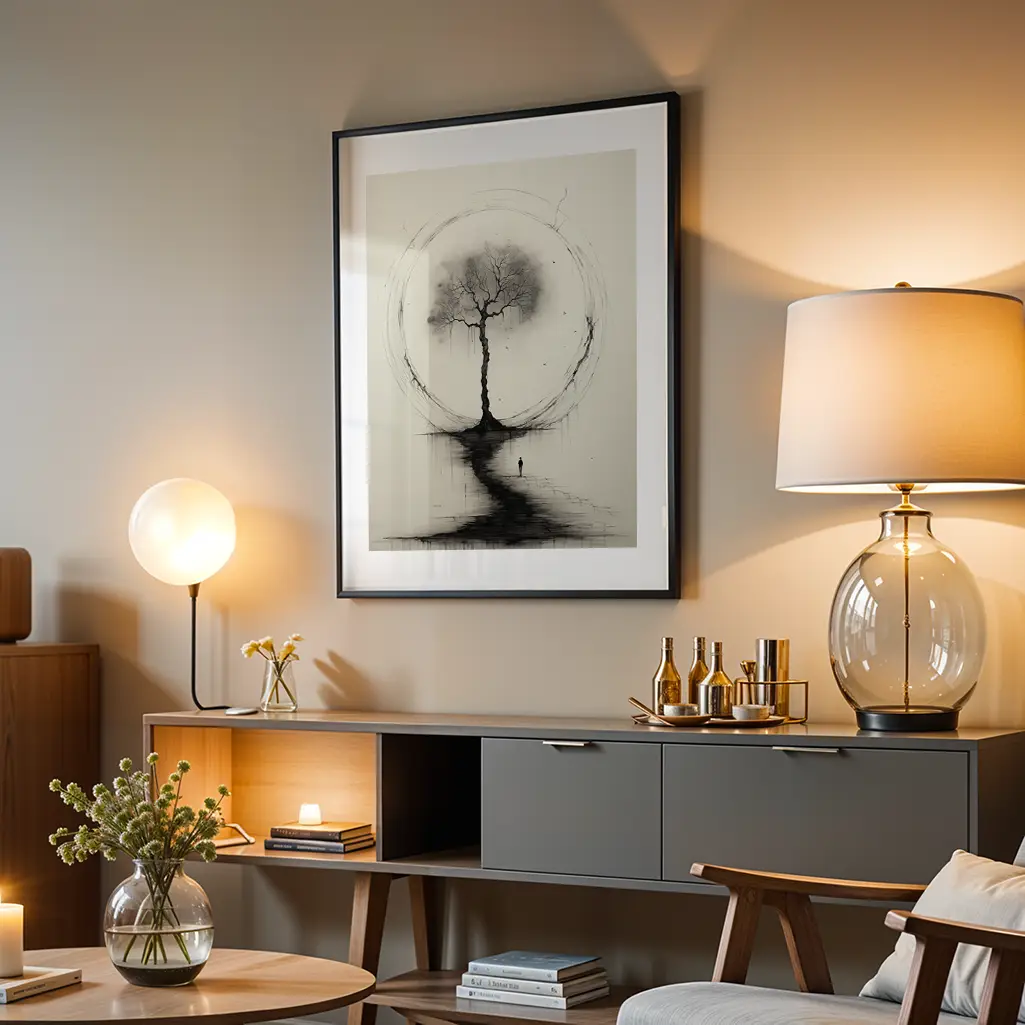
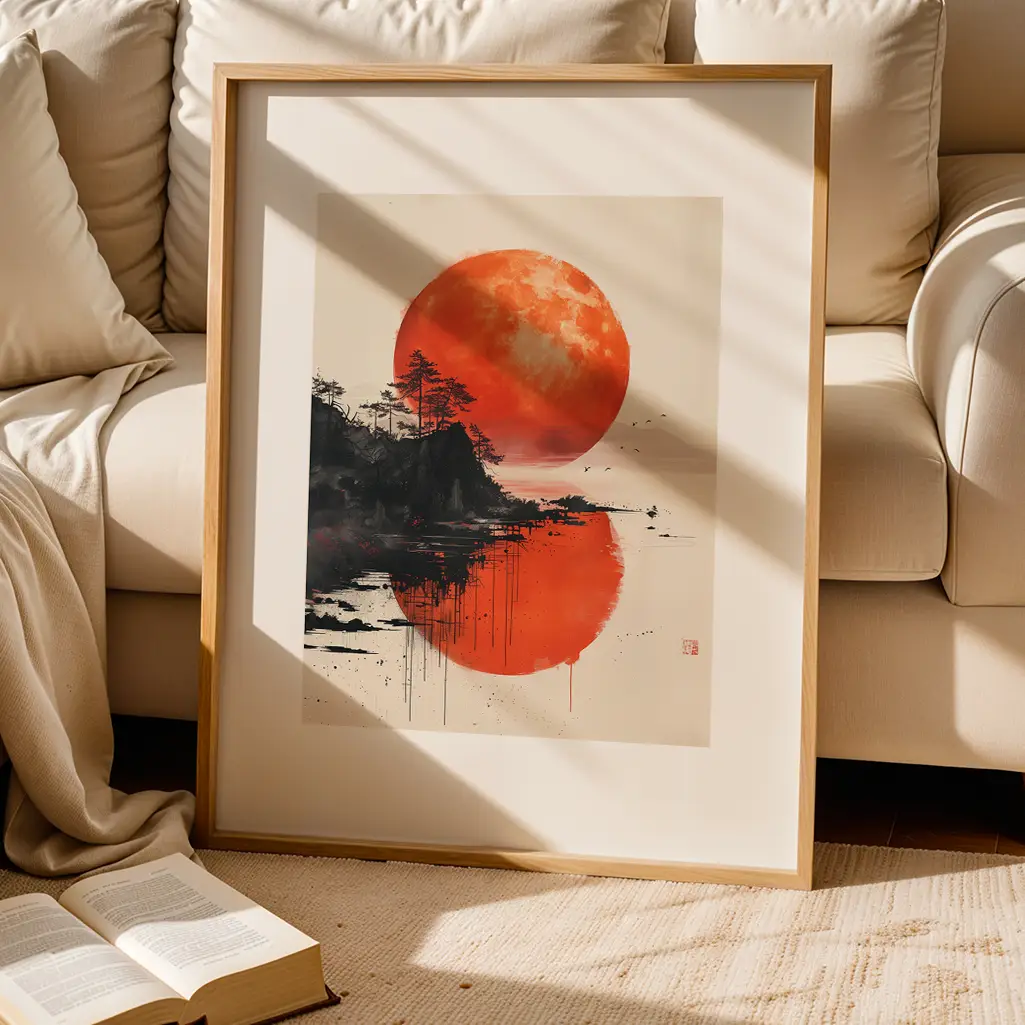
Pay attention to what is at your eye level when you are seated, not just when you are standing. That is the horizon of your everyday life. If it is lined with reminders of unfinished tasks bills, equipment, unread mail your nervous system will treat relaxation as something to be earned later. If instead it holds a framed photograph that reliably softens you, a small plant, or a piece of art with generous negative space, presence becomes easier because your surroundings are not arguing with your intention.
Sound and scent work in similar, often overlooked ways. A single fabric panel or heavy curtain can take the edge off echoing rooms that make conversation feel brittle. A small rug under a coffee table can quiet the clatter of cups and keys. A subtle, consistent smell think fresh air from a cracked window, or one candle reserved for evenings signals to the body that it has moved from the outer rush to an inner tempo.
Creating Ritual Zones Instead of Work Zones
Productivity culture trains us to carve out “workstations” in every available corner: the laptop at the kitchen island, the planner on the couch arm, the phone on the bedside stack of books. Designing for presence inverts that logic. Instead of multiple work sites, you create a few deliberate ritual zones that anchor how you want to feel.A ritual zone is defined less by furniture and more by what reliably happens there. A chair by the window becomes a morning landing pad when it hosts the same mug, the same folded blanket, maybe the same notebook. The predictability is the point. Over time, just seeing that corner cues your body toward a specific state that has nothing to do with output. Your attention arrives more quickly because the space has practiced with you.
You can do this at almost any scale. A small tray on a coffee table that holds a book you are actually reading, not aspirational clutter, and a simple object you like to handle becomes a micro zone for ten minute pauses. A low shelf in the bedroom, cleared of all but a lamp and one object that feels like you now rather than you in five years, becomes a nightly check in instead of a parking lot for devices.
Boundaries matter here, not as rules but as kindness. Decide where work is allowed to live and, more importantly, where it is not. If the dining table must serve as a desk, give that dual role a beginning and an end. A cloth that appears only after working hours, a bowl that gathers chargers and cables and is then moved out of sight, a deliberate clearing of the surface before meals each of these tiny gestures tells your nervous system that the room has changed roles.
Presence also asks you to accept some friction. Leaving a book open on the arm of a chair rather than on your phone screen means you have to walk across the room to re enter the story. That short walk is not inefficiency; it is a physical threshold that distinguishes one mode of being from another. When every activity happens from the same posture, on the same device, in the same spot, time blurs and days feel strangely thin.
The paradox is that rooms designed for presence often make you more effective when you do choose to work, precisely because they have not been nagging you all day. By giving yourself spaces where nothing is being asked of you, you remember what your attention feels like when it is not being pulled. That quality of attention is ultimately what you carry out of the room and back into the world: not productivity, but a clearer sense of how you want to be while you do whatever you do next.