The room behind the screen
We often talk about screen time as if it were only a number, an intake to be tracked like calories. Yet what shapes your mind more than the hours is the room your screens live in, the rituals that surround them, and the quiet you allow between each digital ripple.In a Zen frame, the question is not whether screens are good or bad, but whether they help you see your own mind clearly. The problem is "digital noise": not just sound, but the invisible hum of alerts, unfinished messages, and glowing rectangles waiting to be checked. That hum seeps into walls, colors, even the way you sit on the sofa.
Look around your living room for a moment. Every visible device is a small, silent request: "Touch me. Check me." A tablet on the coffee table, the laptop left half-open at the dining chair, the television looming like a dark mirror. Each one is a doorway out of the present room. Design, in this context, becomes a kind of gatekeeping: you can decide which doors are obvious, which are subtle, and which are hidden behind a screen of their own.
Traditional Zen rooms are almost unnervingly bare: a tatami mat, a low table, maybe a scroll and a simple flower arrangement. Nothing demands attention, so attention can rest where it naturally falls. Translating that ethos into a home that must host Wi-Fi, work calls, and movies is less about pretending technology does not exist and more about acknowledging its power, then giving it walls.
One practical starting point is visual silence. When the television is off, is it still the visual center of the room? If so, the room continues to shout, even in standby mode. Designers sometimes recess the screen into a dark niche, let it double as framed art, or flank it with generous negative space so it ceases to dominate. The goal is not to hide technology out of shame, but to place it in proportion to everything else that matters: a window view, a bookshelf, a low plant catching late light.
Digital noise is also architectural. An open-plan space where the work desk bleeds into the sofa and the kitchen invites work emails to float into breakfast, then into late-night scrolling. Creating even a symbolic threshold—a small rug that marks the "work zone," a folding screen that closes over the desk at night, a cabinet that swallows the router and charging hub—signals to your nervous system that the day has edges. You begin to feel where the laptop ends and the living room begins.
Designing for interruption and stillness
Once you accept that screens are here to stay, the design question shifts: How do you arrange your home so that interruptions have to work harder, while periods of stillness feel effortless? Zen practice offers a clue: change the conditions, not the willpower. Instead of trying to fight each ping, shape your space so there are fewer pings, and more reasons to look away.Consider the path your gaze takes when you enter a room. If the first thing you see is a glowing rectangle, the room has already made the choice for you. If instead you meet a quiet focal point—a low bench by the window, a piece of art at eye level, a small altar of everyday objects—a different kind of attention steps forward. You have created a visual invitation to arrive before you connect.
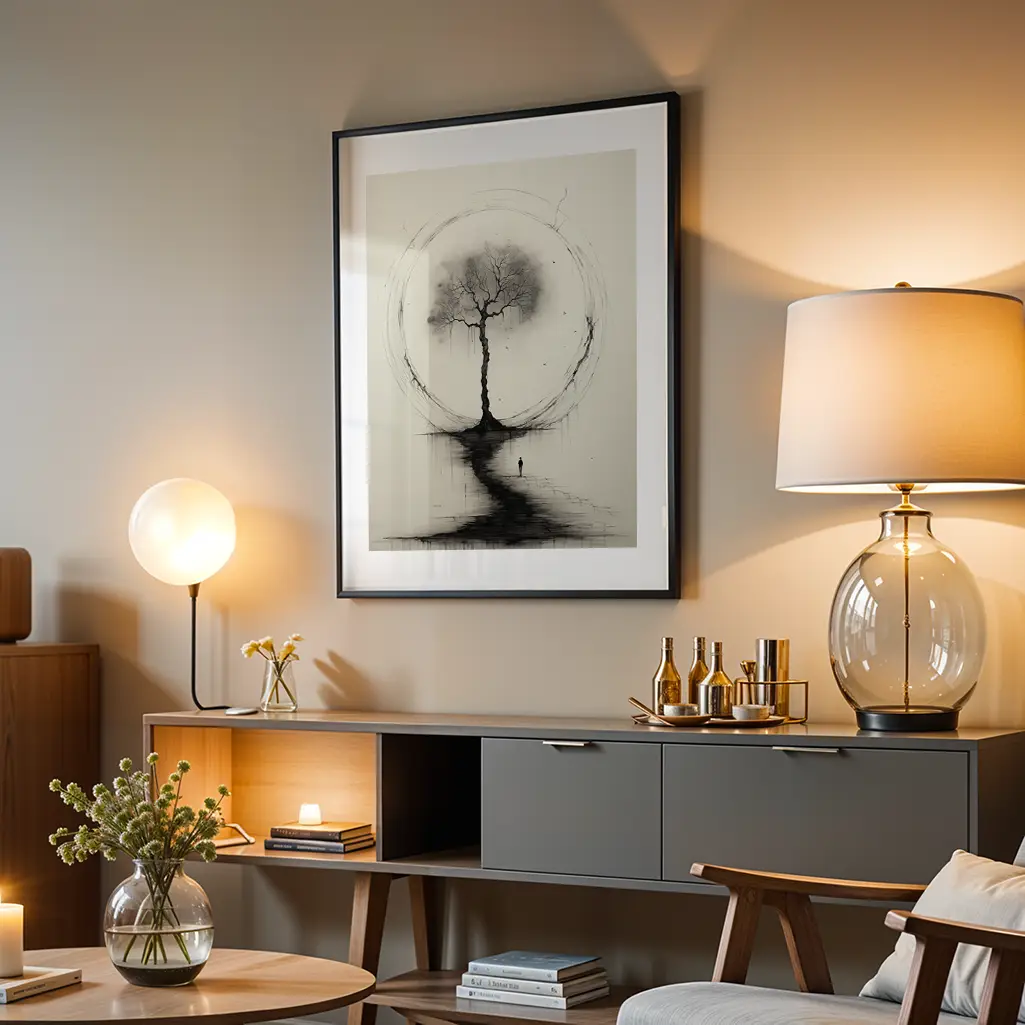
Light plays its own role in the drama of attention. Blue-white light from a screen is jittery; it flattens depth and sharpens edges. Warm, layered light—floor lamp, small table lamp, perhaps a candle—softens perception and signals that you are offstage. A Zen approach encourages lighting that supports the activity of the room. Task light at the desk; diffuse pools of light where you rest. When the only strong light source at night is the television, the entire room becomes a theater for distraction. When light is balanced, the screen is one actor among many, not the director.
Furniture placement can either amplify or dampen digital noise. A sofa that faces a television by default treats watching as the baseline. Rotating seating so that conversation or a window view is the primary axis changes the script: the screen is available, but not assumed. Likewise, keeping handheld devices on a distant console or a dedicated tray means you must stand up and cross the room to retrieve them. That small effort is a filter; many impulses to check will dissolve before you reach for the phone.
The sounds of your home matter as much as its shapes. Constant background audio—from podcasts, news, or auto-play videos—prevents the mind from touching silence. You might consciously weave in "acoustic pauses": minutes when no speaker is on, when you can hear the refrigerator hum, the hallway echo, the faint traffic outside. This sensory minimalism is not an aesthetic for photographs, but a training ground for attention.
In a Zen monastery, bells mark time, calling practitioners back to the present. At home, you can invert the bell: instead of a device asking for you, you ask for the device at chosen times. That might mean a visible, analog clock on the wall so the phone need not be the keeper of minutes, or a small paper notebook by the bed so late-night ideas do not require unlocking a glowing portal.
A quieter self in a wired world
Ultimately, the battle between digital noise and inner quiet is not about rejecting screens but about reclaiming authorship over how they inhabit your space and your mind. When you place a device, you are also placing a habit. When you design a room, you are also designing a state of mind that will visit you again and again.There is a subtle dignity in choosing restraint. Leaving one wall mostly empty so that the eye can rest; allowing a low table to hold only a single book and a sprig of green; giving each device a specific home so it does not sprawl across every surface. These gestures may feel small or even fussy at first, but they become a form of spatial meditation. Each time you return your phone to its tray, or close the cabinet over the router light, you are rehearsing the movement of letting go.
Inner quiet is not the absence of technology. It is the felt sense that you could put the device down at any moment and the room would still be full, that your attention has somewhere gentle to land. A warm throw on the arm of a chair, the grain of wood catching morning sun, the familiar weight of a ceramic mug—all are analog anchors, reminders that reality remains textured and three-dimensional even when the screen is dark.
Designing your home in a Zen spirit does not demand perfection. There will be days when the laptop colonizes the dining table, when notifications leak into midnight. But each experiment—a dedicated charging station at the entry, a screen-free corner with a floor cushion, a habit of dimming lights before turning on a show—tilts the balance. Over time, your rooms begin to whisper a different script: you may watch, you may scroll, and you may also simply sit.
In that simple sitting, surrounded by objects and light you have chosen with care, the digital world does not vanish. It shrinks to its proper size. The screen becomes one tool among many, instead of the air you breathe. And in the space that opens around it, inner quiet has room to unfold, not as an escape from the wired world, but as the calm center at its heart.