Seeing Your Home as a Quiet Conversation
Feng shui begins with a shift in how you see your rooms. Instead of thinking of your home as a backdrop for life, imagine it as a quiet conversation between your inner world and the objects, light and movement that surround you.Traditional feng shui is complex, rooted in ancient Chinese philosophy and detailed calculations, but at home level you can embrace its spirit without charts or compasses. At its core is one steady question: "Does this space support or drain me?" Everything else is a refinement of that inquiry.
There are a few ideas that help before you walk room to room. The first is flow. You experience flow every time you walk from the front door to the kitchen or from the sofa to the window. Notice where you hesitate, bump a corner, twist sideways or step around piles. Those tiny frictions are what feng shui calls stuck "chi"—places where movement, and often emotion, has stalled.
The second idea is balance. Homes tilt in certain directions: some feel visually heavy and dark, others overlit and restless. A room mired in greys and black metal can feel as flat as a rainy day that never lifts. One drenched in bright white and overhead glare can feel like a waiting room. You do not need to memorize formal "five elements" to respond. Ask instead: "What is too much here, and what is missing?" If a space is moody and dense, you bring in lightness: a pale rug, glass, a plant. If it is sharp and clinical, you introduce warmth: textured textiles, wood, books, a softer lamp.
Finally, there is intentional placement. Feng shui is famous for its "command position": arranging key pieces so you can see the door without being directly in line with it. This is not mysticism; it is nervous system logic. When you are not startled by what is behind you, you can read, rest or work more deeply. In each room, you will be playing a quiet game of rotating furniture until your body relaxes.
With those three ideas—flow, balance and command—you can move through the home, adjusting each room without turning your life upside down.
The Entry, Living Room and Kitchen: Where Energy Arrives and Gathers
In feng shui, the entry is "the mouth of chi"—where experience enters. Instead of a shrine to shoes and mail, imagine it as a gracious pause. If the first thing you see is clutter, bags slumped on the floor or a tangle of coats, your body registers fatigue before you even drop your keys.Start with a clear path from door to interior. If you need storage, choose closed solutions: a bench with drawers, a cabinet that hides the daily chaos. A small lamp, a simple artwork or a plant turns the threshold into a welcome rather than a warning. The goal is not minimalism but clarity: a sense that the home knows where things belong.
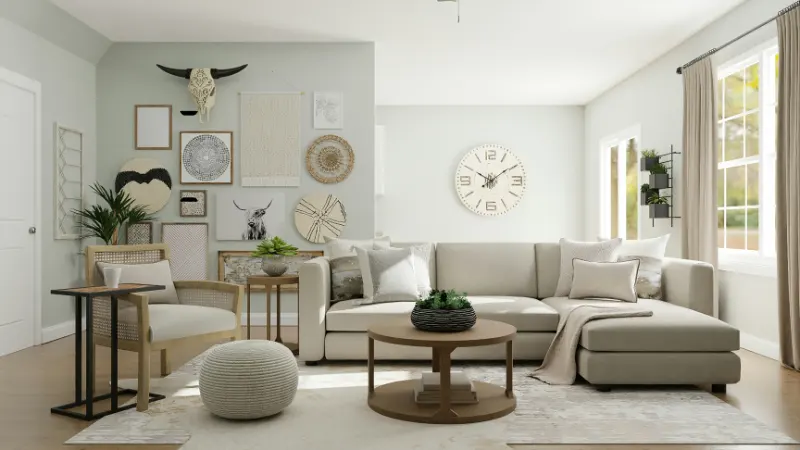
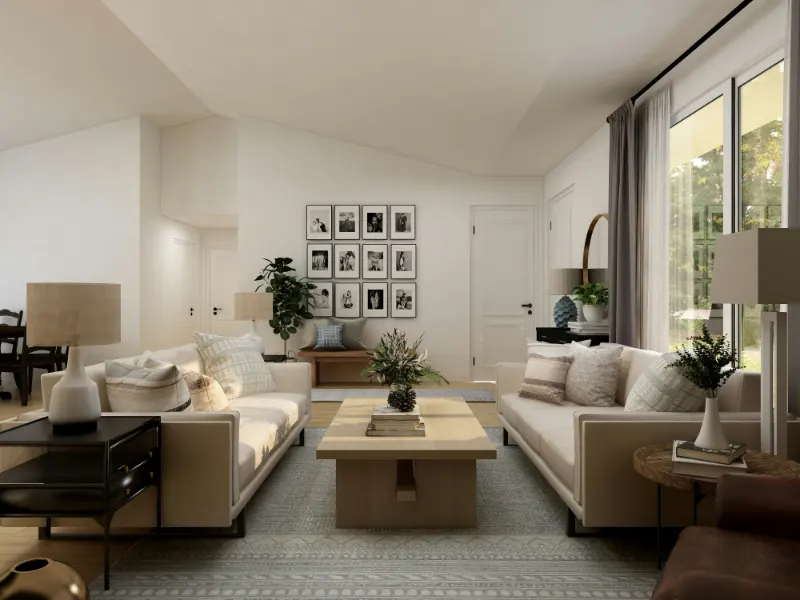
In the living room, you spend extended, unguarded time; feng shui treats it as the social heart. The main seat—often the sofa—works best when it can see the entry to the room without being shoved directly along the door’s line. If your back is to the door, experiment with rotating the furniture or placing a slender console and lamp behind you so that the vulnerability softens.
Flow here is about conversation as much as walking. If every seat faces a screen, the room’s attention narrows. Try a layout where chairs turn slightly toward one another, where you could set down a cup of tea without performing acrobatics. Layer lighting: an overhead fixture can be crisp, but without a floor lamp near a reading chair or a table lamp by the sofa, evenings feel two-dimensional. Think of light as the brushstroke that tells the room when to be lively and when to exhale.
The kitchen marries practicality with nourishment. In everyday feng shui, the stove is symbolic: it is where raw ingredients are transformed into care. Keep this zone clear enough that cooking feels inviting, not like a logistical battle. Rather than covering counters with appliances, select one or two that genuinely earn their place. The rest can live in a cabinet, returning only when needed.
If the room feels harsh—gleaming steel, hard tile, humming appliances—counterbalance with softer elements. A simple runner breaks the echo of the floor, a wooden bowl of fruit warms a cool island, a small herb pot by the window reconnects the space to something living. Ventilation matters more than many realize; opening a window or using a fan after cooking allows the room’s energy to reset instead of lingering in a heavy cloud.
Bedroom, Workspace and Bathroom: The Art of Rest and Renewal
Where the front rooms of a home are public, the bedroom and workspace are intimate negotiations with your own attention. Feng shui treats the bed as one of the most important objects you own, not because of its style, but its position. If possible, place the headboard against a solid wall, with a clear view of the door yet not directly aligned so your feet point straight out to it. This arrangement mimics the instinct to sit with one’s back to a hill and eyes on the valley.Side tables on both sides of the bed create a sense of equality and stability, even if you sleep alone. Resist the temptation to let them dissolve into charging stations and medicine cabinets. A small dish for a ring, a single book, a carafe of water; restraint keeps the bedroom from becoming an extension of your inbox.
Screens are the most persistent modern disruption. Feng shui does not need to outlaw them to work; it simply asks you to consider what you fall asleep to. If removing the television is impossible, at least ensure it is not the focal point. A fabric panel, a low cabinet that allows concealment, or simply turning it away from the bed temperature of your nervous system.
In a workspace, the command position becomes almost literal. If you work with your back to a door, your body reads every sound as a potential interruption. When you can turn the desk to face the entrance, supported by a wall behind, the whole room feels more authoritative. Where space and wiring do not cooperate, a high-backed chair and a small mirror angled so you can see the doorway are imperfect but effective compromises.
Clutter here has a different weight than in the living room. Piles of unfinished tasks broadcast a constant whisper of "not yet, not enough." Consider a rhythm: at the end of the day, five minutes to close notebooks, stack papers, and clear the desk surface, even if the project is ongoing. You are not pretending the work is finished; you are signalling to your mind that there is a boundary between doing and resting.
Bathrooms, often dismissed as purely functional, hold a quiet symbolic role in feng shui because they involve both cleansing and constant water leaving the home. The practical version of this: keep drains unclogged, lids closed, and the space as cared for as any other room. Harsh, cold bathrooms can make morning routines feel like an obligation. A softer light bulb, a simple mat, and one or two well-chosen objects—a framed photograph, a sprig of eucalyptus—shift the room from utility to ritual.
Across all rooms, the beginner’s form of feng shui is not about chasing perfection or exotic cures. It is about refining your sensitivity. Each time you enter a space, pause for a second and ask what your shoulders do, how your breathing changes. The adjustments that follow—moving a chair, clearing a surface, inviting a plant into a dim corner—are less about obeying rules and more about learning to design alongside your own nervous system. Over time, the home becomes not just prettier, but kinder.