The Quiet Power of a Present Room
Your living room is often the stage set for your daily life, yet many rooms feel slightly out of sync with the people who live in them. A “present” living room is not about perfection or trend; it is a space that meets you where you actually are, and gently brings you back to the moment.Presence in a room begins with attention. Notice what you do here most: conversation, reading, phone scrolling, half-finished hobby projects. A present room does not erase those realities; it arranges itself around them. Instead of aspiring to an abstract ideal, it acknowledges the way you really live and turns that into the design brief.
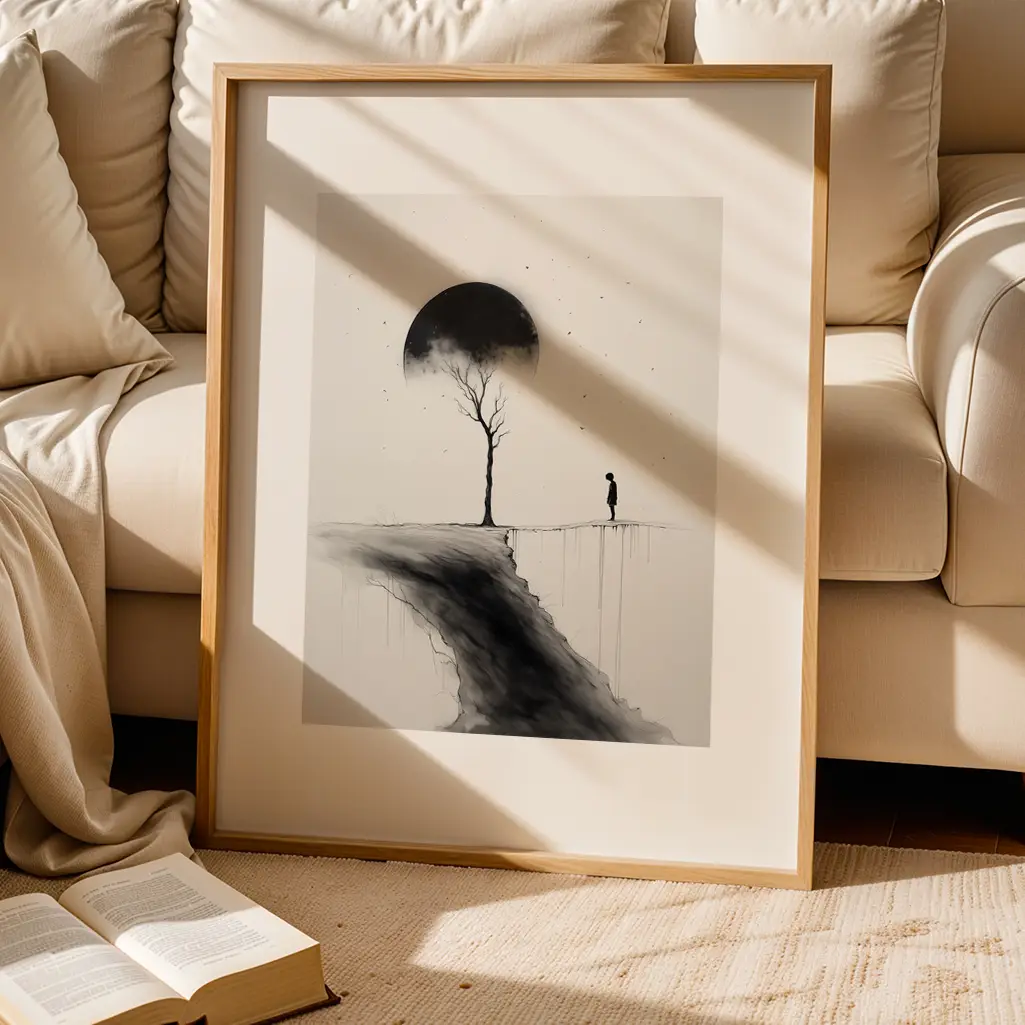
Start by experiencing your room as if it belonged to someone else. Stand at the threshold. What is the first thing your eye lands on? Does that first impression feel considered or accidental? A looming TV, a random tangle of cables, the back of a sofa pushed against the door opening will all pull you out of the moment. A considered focal point, by contrast, invites you in. It could be a low arrangement of books and a lamp, a quietly scaled artwork, or a view framed by open curtains. The content matters less than the clarity of that first visual sentence the room speaks.
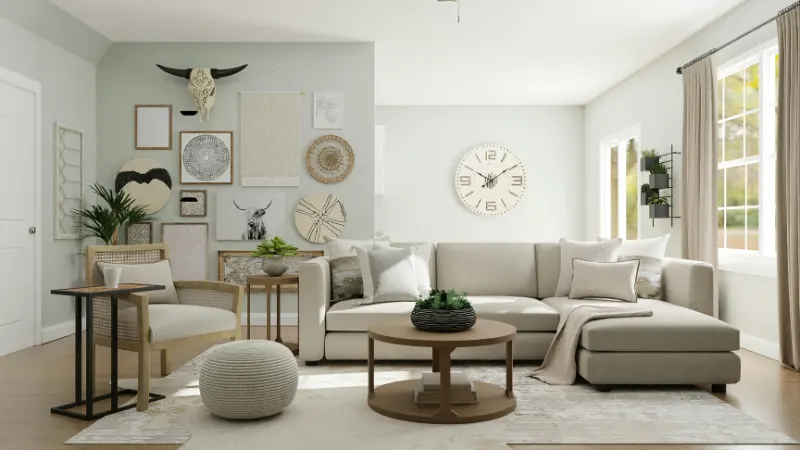
Presence also means that the room is legible. You can tell how it wants to be used at a glance. A sofa with a small table within natural reach, a chair under a pool of warm light, a soft surface where a child might sprawl with a puzzle: these are visual cues that say, this is what happens here. When the room’s language matches your life, you feel less scattered in it. That calm recognition is the beginning of a more present home.
Light, Layout and the “Now” of the Room
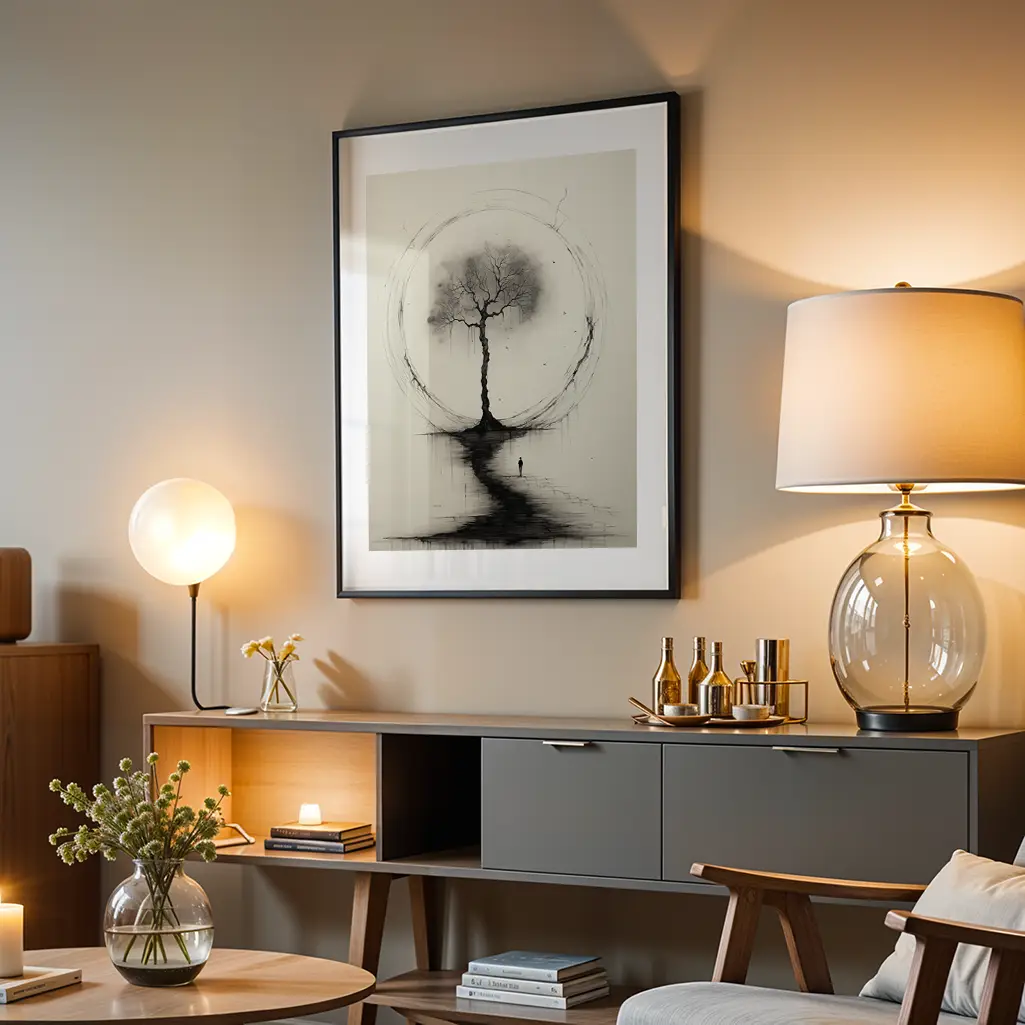
If presence has a main material, it is light. Harsh overhead glare flattens everything into a kind of permanent noon that is indifferent to how you feel. A present living room modulates light the way your body modulates breath, expanding and softening across the day. During daylight, let the room orient around whatever natural light you have. Open heavy curtains, strip back unnecessary blinds, and clean the windows more often than you think you need to. Even a narrow shaft of daylight can become a small altar to the present if you clear a path for it.In the evening, trade singular brightness for layers. A floor lamp for reading, a table lamp near the sofa, a small accent on a shelf: each source casts a pocket of intention. The room feels more present because you are no longer washed in anonymous light; you are held in specific areas of attention. Dimmer switches are helpful not because they are sophisticated, but because they acknowledge that your needs are different at 6 p.m. than at midnight.
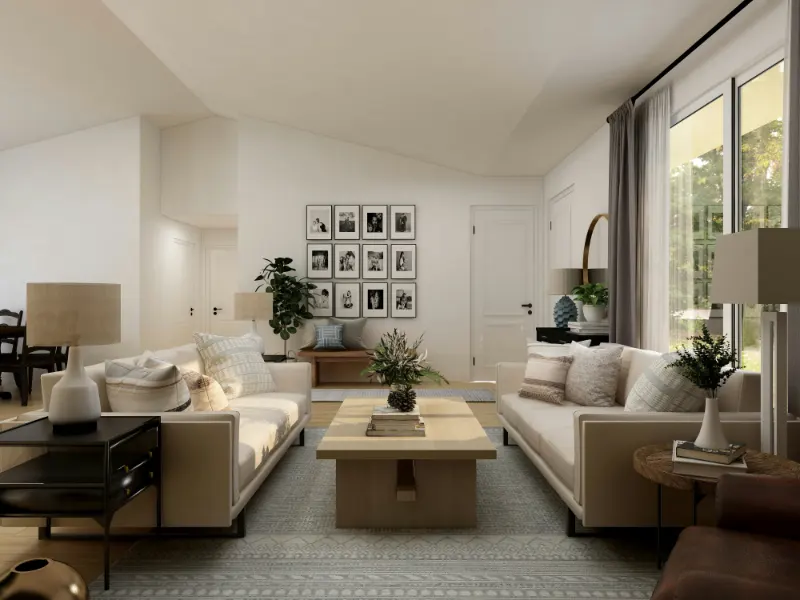
Layout is the second structure of presence. Many living rooms are arranged around anxiety rather than life: the fear of blocking a window, the obligation to center everything on the largest screen. Try instead to arrange around relationships. Imagine lines of connection between the seats. Can two people speak without twisting their necks? Can someone read while another watches something without feeling exiled? A sofa and a single chair facing each other across a low table will be better for real conversation than three seats all lined up toward a wall.
Pay hidden attention to pathways. If you have to zigzag around furniture to cross the room, a part of your mind is always negotiating obstacles. A clear route, even narrow, lets your body move without calculation, which frees up attention for the people and activities in front of you. Presence is partly the absence of micro-friction.
Sound, often forgotten in design, shapes how present a room feels. Soft textiles, curtains, and upholstered pieces absorb the sharp edges of noise, so the room does not echo like a hallway. A rug that quiets footsteps, a throw over a hard-backed chair, books on a shelf: they all tune the acoustics toward listening. In a calmer acoustic field, small sounds read as part of the moment rather than irritants, and the room feels more settled around you.
Objects, Rituals and Editing in Real Time
The things you leave visible in your living room either pull you backward and forward in time or hold you in the present. Stacks of unsorted mail, bags waiting to be returned, gadgets charging on every surface all represent deferred decisions. They whisper of what you have not done yet. A present room is not empty of life, but it resists becoming a storage site for unresolved tasks.One way to bring the room into the present is to define a small, precise home for the necessities of your daily orbit. A tray by the sofa for remote controls, a shallow bowl for keys, a low basket for today’s blanket. The boundaries are not decorative; they are psychological. When each ongoing thing has a place, its presence stops feeling like a question mark. You can then choose a few objects to keep in your line of sight that speak to who you are now, not just who you were. A book you are actually reading this week, a small plant you are managing to keep alive, a work in progress on a side table: these all signal that life here is unfolding, not stalled.
This does not mean stripping away memory. A photograph, a bowl from a trip, a piece of inherited furniture can absolutely live in a present room. The key is whether you still have an active relationship with it. If an object only reminds you of obligations or loss, you might move it to another part of the home or give it a quieter role. The living room is the public face of your inner life; let it be curated toward the kinds of feelings you want more of.
Finally, presence is not a one-time styling session; it is maintained by ritual. Small, repeatable gestures can re-tune the space at the edges of the day. In the morning, opening curtains, folding the throw on the sofa, clearing last night’s glass from the table. In the evening, switching on only the lamps you need, placing tomorrow’s book in reach, straightening a cushion enough that sitting down feels like an invitation rather than an afterthought. These acts are less about neatness than about intention. You are quietly telling the room, and yourself, that this is where your attention belongs now.
Over time, these choices accumulate. The light becomes kinder, the seats more oriented to conversation, the objects more aligned with your current life. The room starts to feel less like a backdrop you pass through and more like a participant in your day. That is a present living room: one that keeps meeting you, moment after ordinary moment, exactly where you are.