
The Quiet Geometry Behind Straight Art
A crooked frame is rarely just about the frame. It speaks to the tension between the way we imagine our homes and the way they actually look at 8 p.m., lamps on, shadows long, the day already smudging the edges of our intentions. Learning how to hang art straight without stress is not only a technical problem; it is a small domestic philosophy.The obvious enemy is gravity, but the subtler adversary is our own impatience. Most people either eyeball everything and hope, or they over-engineer the process until the wall feels like a math exam. The calm, design-forward approach hides somewhere in between. Straight art depends on three things: a stable reference line, a trustworthy system, and the confidence to stop fussing when the piece feels right in the room, not just on the measuring tape.
Start by deciding what “straight” even means in your space. Walls are rarely perfectly plumb; floors slope, ceilings dip, and vintage apartments lean like ships in slow motion. If you rely on a single corner or baseboard to define level, you may simply be aligning yourself with a flaw. Instead, let your eye choose the hierarchy. In most homes, the horizon of the room is defined by the line of the floor as you stand in the primary viewing position, or by a dominant element such as a sofa back, credenza, or headboard. This is the line you will harmonize with.
Once you know your visual anchor, bring in the literal one. A basic bubble level still works beautifully, but the game changes when you accept that you do not need to juggle tools and a frame with the theatrical flair of a street performer. Lay the artwork face down, measure the distance between the top of the frame and whatever hardware will actually catch the nail, and write that number lightly in pencil on painter’s tape stuck to the back. Now whenever you hang, that measurement travels with the piece; you are building a system, not reopening the puzzle.
The stress often appears in the final inches. You are standing on a step stool, fingers sliding along the wire, frame swinging like a pendulum. This is where people start muttering and promising themselves never to buy art again. Pause instead. Rest the bottom corners of the frame lightly against the wall, find the hardware, then let the frame settle before you even check the level. If you have done the quiet geometry in advance, this moment becomes adjustment, not improvisation.
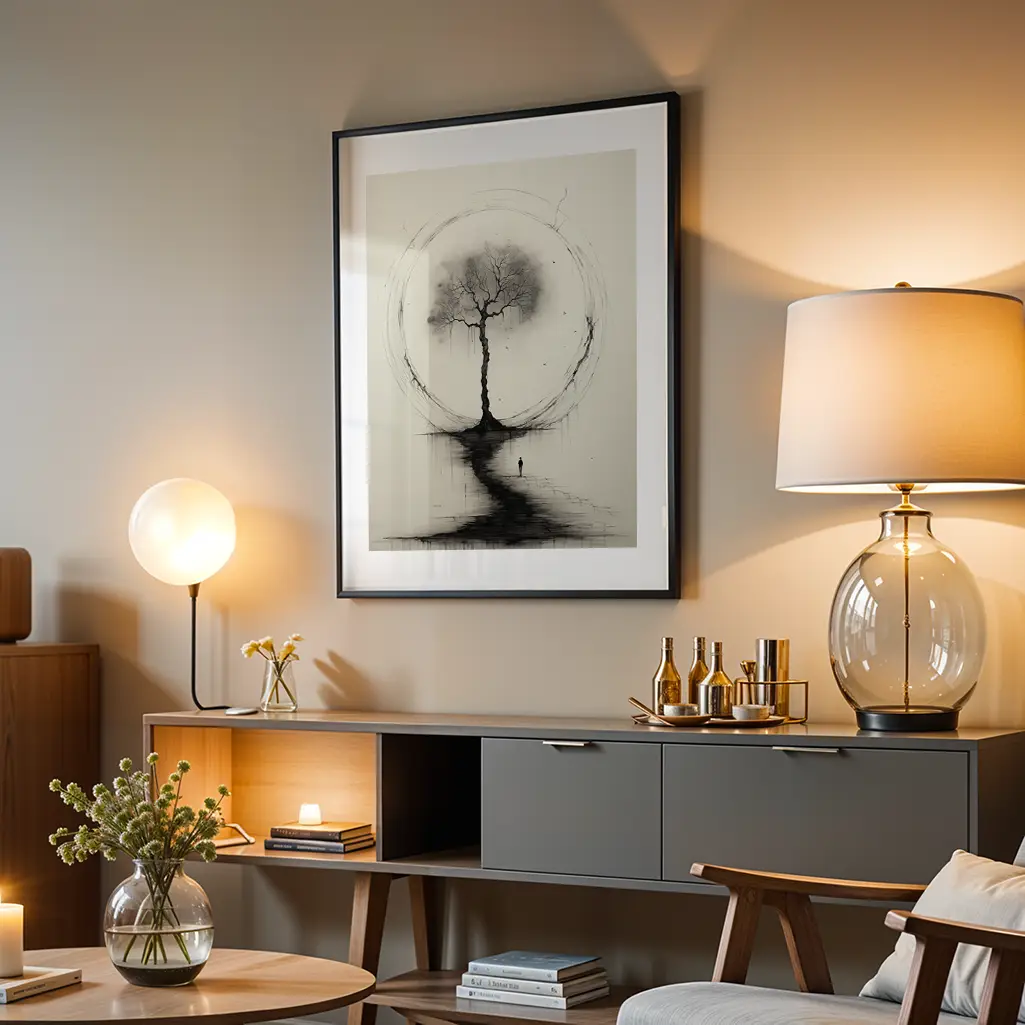
A good rule of thumb is to hang the center of most artworks roughly at eye level, often around 57 to 60 inches from the floor, favored by many museums. But what matters more is relational height. Above a sofa, for example, the art should feel like an extension of the furniture, not an isolated planet. Six to eight inches above the back of the sofa is usually calmer than a lonely frame floating a foot higher. Straightness, in this sense, is less about perfection against an abstract grid and more about alignment with the life below it.
Design Calm: From Single Frames to Quiet Galleries
Once you are comfortable hanging a single piece straight, the real test comes with multiple works. Gallery walls have the reputation of being chaotic, but the most relaxed ones feel like a paragraph, not an argument. To lower the temperature, you begin on the floor, not the wall. Lay your artworks out in front of the surface you plan to use, roughly mirroring its dimensions. As you move the pieces around, look for shared lines: the tops of frames that sit at similar heights, or an invisible vertical that two or three works can share.Pick a single, calm axis to control. That could be the center line running through the middle of the arrangement, or the bottom edge of a row. Measure that line on the wall and give it a light pencil mark at its start and end. Those marks become your spine. Now each frame joins that spine with intention. Even when pieces differ in size, they will feel coherent because they acknowledge the same underlying order.
This is where deep reasoning meets domestic ease. Instead of treating every nail as a fresh decision, you treat the wall as a quiet grid. You may never draw that grid, but you can feel it: repeating intervals between frames, consistent gaps from furniture, a center point anchored to something meaningful in the room. When the underlying pattern is stable, you can hang each new piece with less anxiety, because it is answering a question the wall has already asked.
There is also the psychological side of alignment. Perfectionism masquerades as care, but in interiors it often hardens into a kind of visual tension. A frame that is mathematically straight but emotionally out of tune with the room will always feel slightly wrong. When you step back after hanging, do not zoom in on corners; soften your gaze. Ask whether the art is conversing with the room, or merely performing correctness. If it looks a touch off yet somehow right with the sofa, the window, and the doorway, trust that relationship over the ruler.
To keep things straight in the literal sense, consider the quiet aids professionals rely on. Small clear bumpers on the bottom corners of a frame help it stay put against the wall, resisting the slow drift caused by closing doors or air vents. Two hooks for a wide piece will always be more stable than one; the frame must choose between them rather than oscillating around a single point. These small decisions are like stitching on the inside of a garment. No one sees them, but they make the experience smoother.
In time, hanging art straight becomes almost meditative: measure once with care, commit to a reference line, accept that your walls and your life are not perfectly square, and then let the pieces settle where they can breathe. The reward is not just that guests stop tilting frames as they walk by; it is that your home begins to express a kind of quiet alignment, a visual courtesy you extend to yourself every time you look up.