
Why Rest Feels Like a Problem
We say we want rest, yet many of us overfill our calendars and feel oddly anxious on the rare evenings when nothing is scheduled. The couch is right there; the book is within reach. Instead, we open a laptop or scroll until midnight and call it “unwinding.” When actual rest appears, guilt often arrives with it, whispering that we are lazy, behind, or not “earning” our time.
At the center of this is a quiet belief: that our worth is measured in output. The more visible the output, the more confident we feel. Modern life turns this belief into architecture. Email icons and task lists colonize the home. The kitchen counter becomes a part-time office. Even leisure is repackaged as improvement: fitness trackers, self-optimization, “productive” hobbies. In this environment, stillness can feel like a design flaw rather than a need.
Yet the body has its own, older logic. Fatigue, irritability, and that thin film of anxiety that coats an ordinary day are early warnings, not character defects. Neuroscience quietly sides with the body here: memory, learning and emotional regulation are all sharpened, not dulled, by deliberate rest. The mind consolidates information and sorts experience only when it is not being constantly fed. A rested brain is not off-duty; it is working in a different, less visible way.
The guilt around rest, then, is not evidence that you are doing something wrong. It is evidence that two systems are colliding. One system treats you as a set of metrics; the other recognizes you as a living organism. To rest without guilt, you do not need more discipline. You need a different story about what you are for, and a living space that quietly reinforces that story instead of contradicting it.
Rewriting the Story of Worth
Guilt around rest often sounds very reasonable. It borrows the language of responsibility: “I should be catching up,” “other people are doing more,” “this is selfish.” But underneath these lines is an assumption rarely examined: that time is only justified when it produces something visible and exchangeable. The first step in resting without guilt is to put that assumption on the table and interrogate it like any other belief.
Consider how you describe a good day. Is it a long list of crossed-out tasks, or could it also be a day in which you felt present, kind, genuinely curious? Many people secretly hold a double standard: they understand that others need rest to be well, yet treat their own need for recovery as a moral failing. A gentler measure is to ask, “Did my choices today make me more or less available to the people and work I care about?” Frequently, the hours that look least impressive on a calendar are the ones that restore that availability.
Rest is not the opposite of ambition; it is the soil in which sustainable ambition grows. Athletes train this way intuitively: exertion alternates with recovery so muscles can repair and strengthen. In mental and emotional life, we often attempt the equivalent of sprinting indefinitely. Instead of interpreting fatigue as a cue to slow down, we interpret it as a reason to push harder, then blame ourselves when we crash. The problem is not that we are weak. The problem is that we are ignoring the cyclical nature of effort itself.
One practical way to soften guilt is to name rest as an intentional practice rather than an accidental gap. A short afternoon lie-down becomes a “reset,” not a failure. An evening walk without headphones is “clearing the slate” for tomorrow’s decisions. Language matters because it hints at identity. When you describe rest as something that responsible people do in order to keep their promises to themselves and others, you slowly reframe your self-image from perpetual producer to careful steward of energy.
This mental reframing gains force when your home environment stops arguing with it. A space filled only with cues to produce will keep dragging you back into motion. To rest without guilt, your surroundings must hold the new story alongside you, quietly but persistently.
Designing a Home That Invites Rest
Homes often mirror our nervous systems. Some are tightly wound: surfaces buried under papers, every table a temporary workstation, light harsh and unmodulated. Others go too far the other way, so minimal that there is nowhere to sink and nowhere for the eye to rest. To create a space where you can pause without apology, you are not aiming for a magazine spread but for an atmosphere that says, very simply, “it is safe to stop here.”
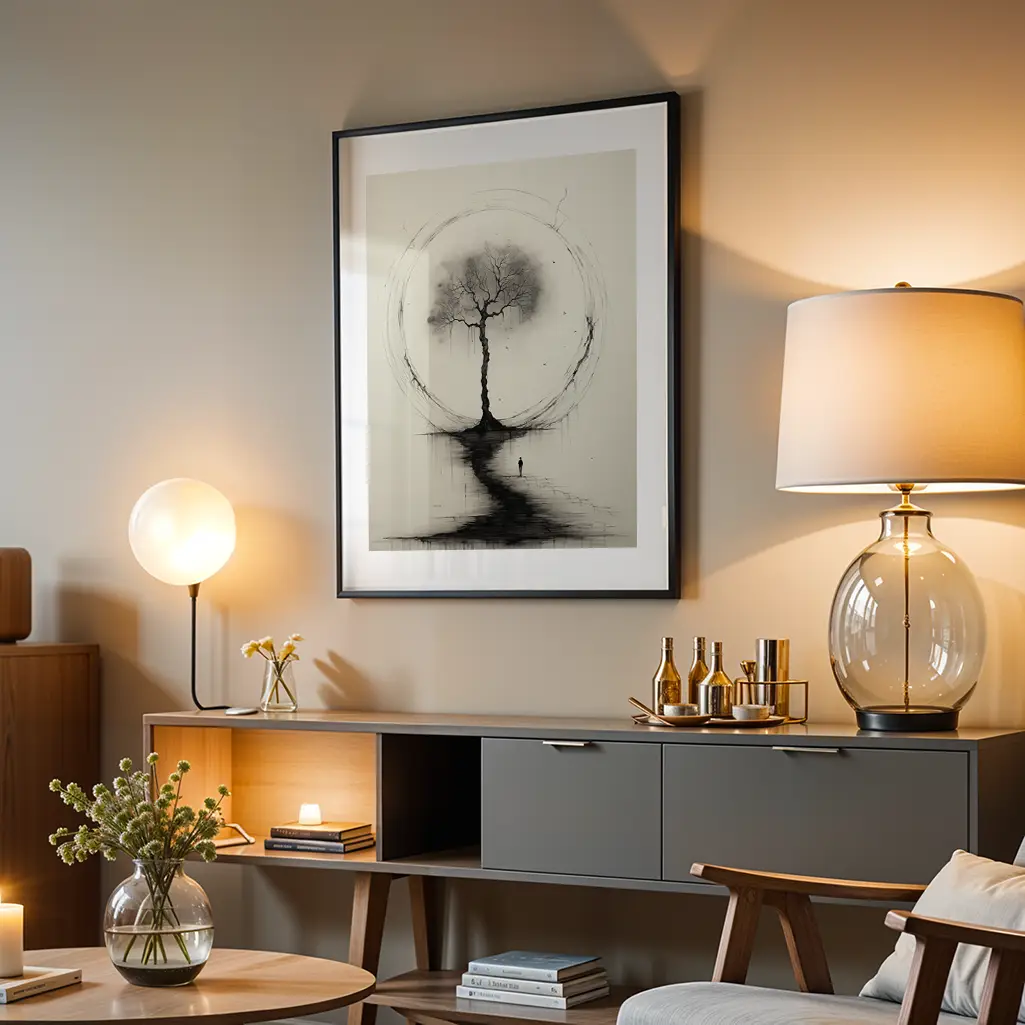
Start by noticing the path your body usually takes through your home after a long day. Do you walk directly toward a desk, a glowing screen, a pile of laundry waiting accusingly in the corner? These are what psychologists call “behavioral nudges” built into space. You can soften them, not by chasing perfection, but by adjusting what your environment suggests you do next. Clearing a single horizontal surface and placing a lamp with warm light can create an impromptu landing zone that invites you to set things down, literally and mentally, when you walk in the door.
Seating is an underappreciated scriptwriter of behavior. A rigid chair facing a monitor quietly prescribes work. A low armchair angled toward a window, with a small table just big enough for a cup and a book, prescribes something else. When you create one or two “rest-first” micro-zones at home, you build in small pockets where the most frictionless choice is to pause rather than continue producing. The aim is not to forbid work, but to stop centering it as the only default posture available.
Light and sound are equally powerful. Natural light during the day regulates the body’s internal clock, making sleep more coherent at night. In the evening, shifting to softer, indirect light is a way of telling your nervous system that the demand for sharp focus is easing. Likewise, not every moment requires audio filling the air. A quiet room with the distant texture of street noise or rustling leaves is a kind of acoustic rest; it grants your attention the right to idle instead of constantly reacting.
Objects in a room can either issue instructions or offer permission. A stack of unopened mail instructs you to worry. A yoga mat permanently rolled out in a corner offers the possibility of ten slow breaths between tasks. A throw blanket draped over the back of the sofa makes lying down a default instead of a decision that must be justified. None of these gestures are dramatic. Their power lies in their ordinariness. They normalize resting as one of the many things this household does, like cooking or talking.
Over time, a home designed with rest in mind begins to act as a quiet ally against guilt. When you sink into a chair that has clearly been placed to catch the last light of the day, it is harder to argue that you ought to be somewhere else. The space itself insists that being here, breathing, unproductive in the narrow sense, is part of the plan. In a culture that rewards relentless doing, this is a quietly radical stance. It is also a deeply practical one. A life that includes regular, guilt-free rest is not less serious or less engaged. It is simply arranged on a human scale, where effort and ease are allowed to take turns, and where home is not a factory, but a place to return to yourself.
.webp)