The Quiet Logic Behind Zen Gardens
Japanese Zen gardens look disarmingly simple: raked sand, a few stones, maybe a patch of moss. Yet that simplicity is the surface of an intricate philosophy about perception, time, and the mind. These gardens were shaped by Zen monks as tools for contemplation, not decoration, and they still function as physical diagrams of how attention moves through space.
At the heart of a Zen garden is an idea that feels almost paradoxical: it is a landscape designed to be "seen" more than "entered." Traditionally, a monk or visitor sits on a wooden veranda and gazes out at the composition. The garden becomes a mental terrain, a place where the eye wanders and the mind follows. Instead of walking paths, the visitor uses visual pathways created by lines in the sand, the tilt of a stone, or the shadow of a wall. Movement is internal rather than physical.
This makes a Zen garden quite different from many Western gardens, which emphasize bloom, color, and seasonal change. In Zen spaces, color is restrained and growth is slow. The main materials, stone and gravel, barely change at all. This sense of near-timelessness gently stresses the Zen perspective that moments pass while reality remains. The garden does not demand constant attention; its power lies in being there, quietly, every day, even when you are not looking.
For a home, this is a refreshing counterpoint to interiors filled with objects that ask for interaction, maintenance, or display. A small Zen-inspired corner, even on a balcony or windowsill, can play a different role: a steady visual anchor that absorbs rather than generates noise. It embodies the question, "What can I remove so that what remains becomes more meaningful?"
The Essential Elements and How They Speak
Every element in a Japanese Zen garden is an actor in a silent play about distance, scale, and the unseen. When you understand these roles, it becomes easier to adapt the language of Zen gardens to your own spaces, even if you have only a square meter of floor or a shallow tray.
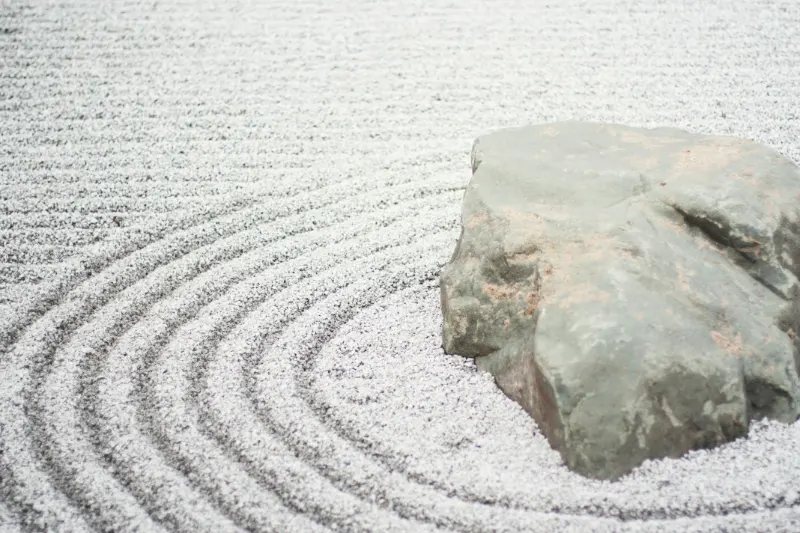
Stones are the most important element. They are not simply "rocks" but mountains, islands, or even figures in conversation. A tall, vertical stone can suggest a peak or a guardian. A low, reclining stone might evoke a shore or a sleeping form. Arranged in small groups, stones create tension and narrative: a cluster leaning toward a solitary stone can feel like a community and an outsider; a pair can read as quiet companionship. What matters is not symmetry but relationship. An arrangement that looks slightly off-balance to the eye can actually feel more alive, because it acknowledges that nature rarely arranges itself in perfect lines.
Gravel or sand plays the role of water and, more subtly, of pure space. When raked into repeated lines, it suggests flowing rivers, rippling lakes, or the slow drift of the sea. When left smooth and flat, it becomes a field of potential, a calm emptiness. The act of raking is itself a form of meditation: the pattern is temporary, easily disturbed, and then redrawn. For a home setting, even a small tray of sand with a few deliberate lines can function as a tactile reminder that order is not a fixed state but a practice you return to again and again.
Moss and small plants add the element of time. Moss creeps, thickens, and softens edges. Where stone and gravel stand for the enduring, moss represents the slow, persistent work of life. It does not shout for attention the way flowers do; it rewards patience and close looking. In an indoor adaptation, you might use a low, spreading plant or a simple patch of green fabric or felt to suggest this softened, living edge, because the visual contrast between the hard mineral surface and the soft green is what carries the symbolism.
Even boundaries matter. A wall, fence, or raised frame around the garden is not merely practical; it creates a sense of "within" and "without." The garden is a world with its own rules of scale and silence. When you outline a small area on a coffee table with a tray or shallow box, you are making a miniature boundary that invites a different kind of attention inside its edges. That boundary is what allows minimal elements to feel complete rather than sparse.
In this way, the meaning of the garden emerges from relationships: between stones and empty space, between stillness and change, between what is shown and what is suggested. The viewer becomes the final component, completing the composition with their gaze and their readiness to slow down.
Symbolism You Can Live With At Home
The symbolism of a Zen garden is not an abstract code reserved for temples; it is a toolkit you can draw on when arranging your own surroundings. Each choice, no matter how modest, can echo the themes that give these gardens their quiet power.
One of the central ideas is that emptiness is not a lack but a presence. In design terms, this means deliberately leaving some surfaces unoccupied, some walls unadorned, some corners uncluttered. The "blank" gravel in a Zen garden allows stones to speak clearly; similarly, a clean tabletop allows a single vase or object to hold emotional weight. Instead of filling every shelf, you can experiment with leaving generous gaps so that each item breathes. The garden teaches that what is not there is doing as much work as what is.
Another theme is the acceptance of imperfection and asymmetry. Zen gardens rarely mirror themselves; they feel balanced without being equal on both sides. You can apply this at home by resisting the urge to center everything or to match every object with a partner. A single chair slightly off-center, a plant tucked to one side of a window, or a group of three objects of differing heights on a mantle can all create a subtle sense of movement that feels more human and less staged.
There is also a symbolic layering of scales. Gravel stands in for oceans, stones for mountains, moss for forests. A small home arrangement can therefore feel surprisingly expansive if you keep this compression of scale in mind. When you place a larger stone near the back of a tray and a smaller one toward the front, you suggest distance and depth. On a shelf, a taller object behind a shorter one can evoke a landscape, especially when colors are restrained. You are not trying to copy a famous temple garden so much as to echo the way it lets the mind travel far inside a small frame.
Finally, Zen gardens embody the value of repetition and ritual. The garden changes mostly through subtle daily acts: raking, trimming, occasionally moving a stone. In a home, this might mean regularly straightening cushions, refolding a throw, or wiping a particular table slowly and attentively. The point is not obsessive tidiness but the cultivation of moments when your hands and mind do one simple thing together. Over time, these moments become part of the emotional climate of the space, just as the steady patterns of a raked garden become part of its mood.
By understanding the meaning, elements, and symbolism of Japanese Zen gardens, you gain more than an aesthetic reference. You gain a way of thinking about space as a partner in your inner life. Even a very small domestic gesture, a stone on a nightstand or a bit of cleared floor, can participate in this larger practice: creating a home where your attention can rest as easily as a stone set firmly in quiet sand.