The Quiet Kitchen: Why Calm Matters More Than Color
A calm kitchen is less about owning the right objects and more about removing the wrong ones. In most homes, the kitchen functions as studio, workshop and stage. It collects the emotional residue of the day: unopened mail, half-finished school projects, the pan you might or might not wash before bed. Designing for calm begins with accepting this reality and then shaping the room so it absorbs daily chaos without visually amplifying it.The visual noise in most kitchens comes from contrast and clutter. Dozens of unrelated packaging colors compete with cookware, cords and magnets. Minimal kitchens are not inherently better; they are simply edited. A minimal space works when it offers just enough visual information to feel alive without tipping into distraction. That balance is achieved far less through expensive finishes and far more through a few repeatable decisions about what stays visible and what does not.
Start with the long views. Stand at the entrance and notice what your eye lands on first: perhaps the refrigerator door, the countertop run, or the window. These areas become your primary canvases. If you do nothing else, bring order here. Clear the counter of anything that is not used daily. If you cannot or do not wish to declutter aggressively, regroup objects into simple families: a wooden tray holding the olive oil, salt and pepper; a single ceramic jar corralling utensils instead of eight mismatched containers. You have not reduced the function, only the number of visual stories competing at once.
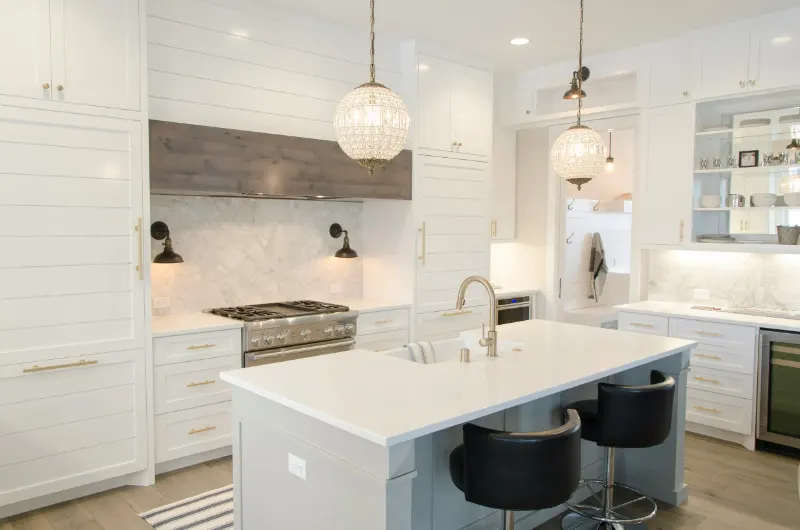
Color is your next lever. Calm does not require a white kitchen. It does, however, benefit from a limited palette, ideally two main tones and one accent. Those tones might be soft grey cabinets and warm oak, or deep navy with pale stone. The point is repetition. When color repeats across cabinets, textiles and small accessories, the room feels intentional, even if you cooked in a hurry and left the cutting board askew. You can keep the existing cabinets and simply align the surrounding items: choose dish towels, canisters and even soap dispensers that echo the cabinet color or the floor, so the entire room feels like a continuous thought.
Texture does the quieting work that pattern often tries to do. Instead of busy backsplash tiles or intensive wall art, consider a few textural contrasts: a linen curtain against a smooth tile wall; a matte stone trivet on glossy counters; a pale woven basket holding fruit in place of a branded bowl. These small shifts soften reflections and shadows, making the room feel more grounded. Calm emerges not from emptiness, but from coherence.
Minimalism as Editing: Surfaces, Storage and the Art of Enough
Minimalism in the kitchen is often misunderstood as a kind of aesthetic austerity, a museum-like stage where nothing is allowed to live. In practice, the most successful minimal kitchens feel deeply used. The difference is that every visible item earns its place. To reach that point in your own kitchen, treat the room like a page layout and ask what truly needs to be in the foreground.Look first at work surfaces. A functional kitchen requires space between tasks: an area to prep, another to land groceries, a clear zone near the stove for pans and tasting spoons. The measuring stick for minimal decor is not how many objects you eliminate, but how consistently you can preserve those work zones. Store infrequently used gadgets in higher cabinets or a nearby closet, leaving the prime real estate to items you handle weekly, not annually. The visual reward is a longer uninterrupted line of countertop, which the eye reads as peaceful, even when an active meal is underway.
Open shelving has become shorthand for minimal design, yet it can easily generate the opposite effect. The test is simple: if every object on the shelf is something you would willingly photograph together, the shelf is working. Group everyday plates and glasses by color and shape, letting repetition create rhythm. Tuck the chaotic pieces behind closed doors. The result is a curated register of daily life rather than a display of everything you own.
Storage is the backstage crew of a minimal kitchen. Deep drawers with dividers, low baskets inside tall cabinets and slim organizers inside narrow spaces all protect your counters from becoming default storage. Even without renovating, you can retrofit existing cabinets with stackable containers and shelf risers so vertical space is not wasted. Think of every hidden compartment as a way of editing the visible scene. The more effectively you store behind the doors, the less pressure you place on your decor to multitask as storage.
The final component of minimalism is what might be called the art of enough. This is not an abstract principle but a very concrete practice. Own enough mugs that you are not washing dishes at midnight out of desperation, but not so many that they spill into two cabinets. Keep enough mixing bowls to cook comfortably, but not enough to form a geological record of your past hobbies. When the quantity of each category is right-sized to your real life, your shelves and drawers cease to overflow, and the entire room feels newly spacious without any structural change.
Making Function Beautiful: Light, Flow and Quiet Rituals
A functional kitchen is not merely efficient; it is also intuitive. The most beautiful decor decisions tend to be those that make everyday movements smoother. Begin with the triangle of stove, sink and refrigerator. You may not be able to relocate them, but you can shape the space around them. Store cookware within a single step of the stove, not across the room. Keep knives and cutting boards close to where groceries first land. Place trash, recycling and compost where you naturally stand when peeling or chopping, so waste disposal is part of the cooking gesture rather than an afterthought.Lighting is both a tool and a decorative medium. Overhead fixtures provide general illumination, but it is the layers beneath that sculpt atmosphere. Under-cabinet lighting, even the simplest plug-in version, shifts the glow down to the work surface and away from your eyes, making evening cooking feel less clinical. A small lamp in a corner of the counter, wrapped in a fabric shade, can turn the late-night kitchen into something akin to a quiet reading nook. When light pools gently on wood, stone and ceramic, the room acquires depth without requiring extra objects.
Functional decor also includes the items you touch constantly. The cutting board can be a piece of art in plain sight if you choose one generous board instead of a stack of plastic rectangles. A single well-made pot left on the stove can act as a kind of sculpture, suggesting hospitality rather than clutter. When you invest modestly in the pieces that live out in the open, you reduce the need for separate decorative accessories.
Finally, introduce one or two daily rituals that complete the space. A small vase that receives whatever branch or herb you have on hand turns the kitchen into a living room for plants. A shallow bowl near the sink where you always drop rings or a watch signals that this is a place where the day is gently put down. These gestures do not belong to any particular design style, but they make the room feel held together by human habit, not by trend.
A calm, minimal, functional kitchen will never be permanently finished. It changes as your cooking changes, as your family grows or contracts, as your morning routine migrates from coffee to tea or back again. The work is not to achieve a static ideal, but to keep listening: which objects are working, which corners gather stress, which surfaces invite you to breathe. When your decor decisions answer those questions, the kitchen becomes what it has always wanted to be, a practical room that quietly takes care of you while you take care of everything else.