
What Shinrin-Yoku Really Means
Shinrin-yoku is often translated as "forest bathing," but the phrase can be misleading if you picture a spa tub under pine trees. In Japanese, "shinrin" means forest and "yoku" means bath, yet the real meaning is less about water and more about immersion. It is an invitation to let the atmosphere of the forest wash over your senses.
The practice arose in Japan in the 1980s as a response to burnout and urban stress. Researchers noticed that time in wooded landscapes lowered blood pressure and eased anxiety. Over time, shinrin-yoku evolved into a gentle form of preventative care, a way to recalibrate the nervous system by stepping into a living, breathing ecosystem.
The power of shinrin-yoku lies in how it reframes your relationship with your surroundings. Instead of treating nature as a scenic backdrop or a place to conquer with steps and stats, it asks you to enter like a guest. You slow down, stop narrating, and let attention spread outward instead of drilling into your phone or your next task.
This shift in attention changes the quality of experience. In daily life we typically look through things, barely registering surfaces, textures or shadows. During forest bathing, the same mind that scrolls and swipes begins to notice a crooked branch, a patch of moss, the way light bends through leaves. The forest is not an inspirational poster; it becomes a precise, intricate room you inhabit.
That way of seeing travels home with you. Shinrin-yoku meaning, in the deepest sense, is that you are part of an environment that is always acting on you. The shape of a tree path, the sound of wind, even the pace of your breath, all feed back into how you feel and think. Recognizing this interdependence is what makes the practice so relevant to anyone who cares about how their home feels, not just how it looks.
The Subtle Mechanics of Forest Bathing
On the surface, forest bathing is simple. You walk slowly through a green space, without a route to complete or a summit to reach. You pause when you feel like it. You might sit, lean against a trunk, or stand and watch. The only requirement is that you keep returning to the present moment through your senses.
This sensory focus is deliberate. Vision tends to dominate our modern lives, but shinrin-yoku gently redistributes attention. You listen for layers of sound: distant traffic undercut by birdsong, leaves shifting above you, the faint tick of an insect. You feel the temperature difference between sun and shade on your forearms. You notice the faint resinous scent of conifers or the dampness of soil. Your sense of smell, usually numbed by indoor air and synthetic fragrances, gets a quiet rehearsal.
As this happens, your nervous system starts to downshift. Heart rate slows. Breathing deepens. The mind, whose default is to plan, replay and label, finds fewer hooks in a landscape that does not ask for opinions. A tree does not care if you like it or if you passed ten thousand steps. This indifference is strangely liberating. There is nothing to win, nothing to prove, only a continuous flow of subtle stimuli that you can either meet or ignore.
Scientific studies have tried to capture this in numbers. Time in forests has been linked to lower cortisol levels, improved immune activity and better sleep quality. But the numbers are only part of the story. Another part is how attention itself becomes more skillful. You practice widening your awareness instead of latching onto the loudest thought. That is a design lesson as much as a wellness technique.
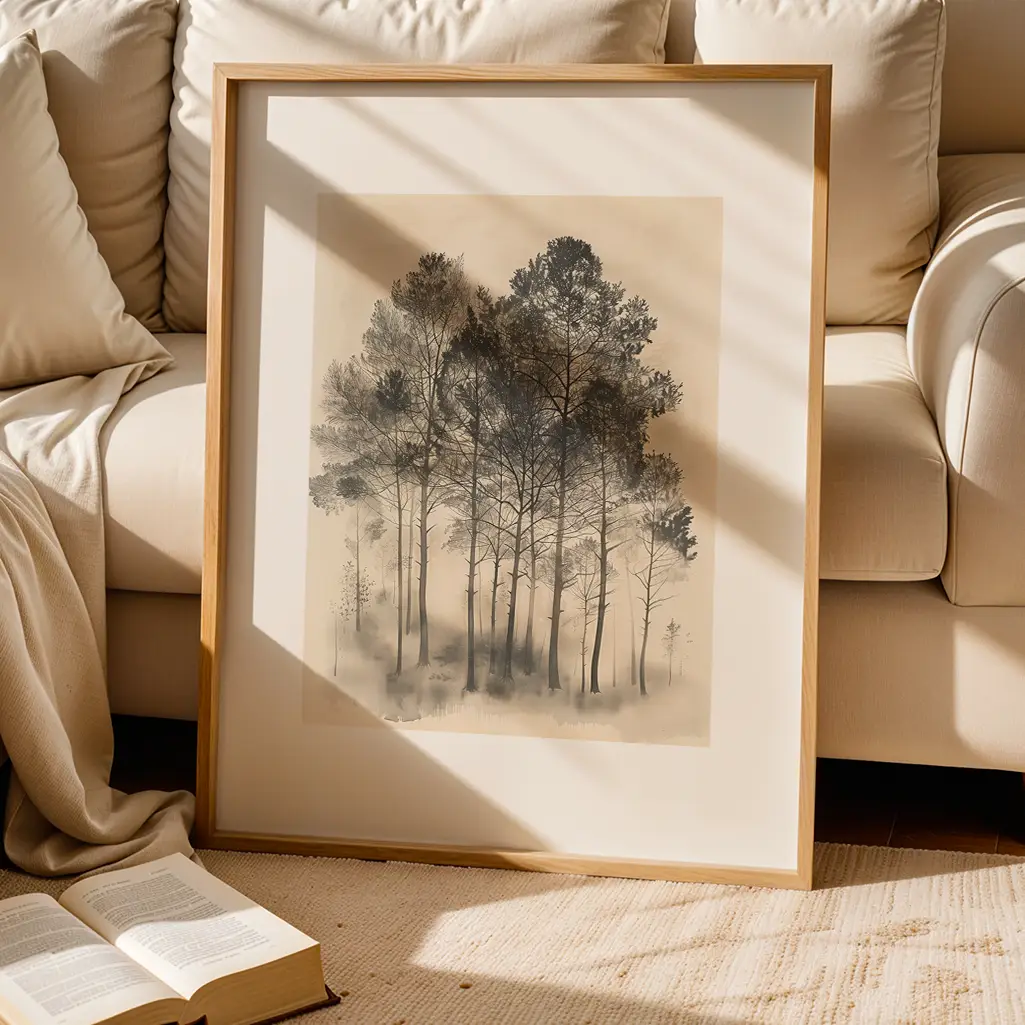
Consider the composition of a forest scene. Vertical trunks rhythmically spaced, a canopy that filters harsh light into soft gradients, a ground plane with small details that reward a slower gaze. It is not random. Natural growth creates a kind of visual rhythm that makes it easy to rest your eyes without being bored. This is the same quality that good interior spaces have: enough order to feel safe, enough variation to feel alive.
The meaning of shinrin-yoku, then, is not only in the forest. It is in how you learn to occupy space with your whole body, to relate to light, air and material more consciously. Once you taste that, even briefly, it becomes difficult to walk back into a cluttered, harshly lit room without noticing how it tightens your shoulders.
Bringing Forest Bathing Wisdom into Your Home
You might not live near a dense forest, and your weekdays might not permit slow walks under towering cedars. But the underlying principles of shinrin-yoku can still shape the way you design and use your home. You are trying to create an atmosphere that invites the same downshift in the nervous system, the same widening of attention.
Start with light. Forest light is rarely direct; it is filtered, dappled, layered. Indoors, this translates into avoiding a single harsh overhead glare when you want calm. Use smaller, lower light sources that bounce off walls or fabric, creating gradients rather than sharp contrasts. A lamp behind a chair or a shaded bulb near a wall mimics the softness of light through leaves more than a blazing ceiling fixture ever can.
Texture is another quiet teacher from the woods. Bark, stone, soil, leaves and water each have a distinct surface quality. When you bring in natural materials, even on a modest scale, you create more points of gentle contact for the senses. A wooden tabletop with visible grain, a woven rug under bare feet, a bowl of smooth pebbles on a windowsill; none of these are decorative in the usual sense. They are invitations to touch, to feel grounded through the skin.
Sound may be the most overlooked dimension of domestic design. Forest bathing highlights how soundscapes affect the body. Indoors, hard surfaces and constant digital noise create a thin, metallic backdrop. Softer materials, bookshelves, curtains and plants can thicken the acoustic texture, absorbing some sharpness and introducing small, organic sounds instead: the rustle of a leaf, the creak of wood, the hum of air rather than traffic or constant media.
Plants, of course, offer the most direct bridge. But the shinrin-yoku approach is not to crowd a corner with greenery and call it done. It is to cultivate a relationship. A single tree in a pot that you see every morning as you make coffee can do more for your sense of connection than a dozen neglected leaves hidden behind a sofa. Notice how the light shifts on its surfaces throughout the day. Pay attention to small new growth, or the way it droops when thirsty. You are training the same attentive, non-verbal awareness that you would use on a forest path.
You can even design small rituals that echo forest bathing. A chair by a window becomes your daily grove. You sit there without your phone for ten quiet minutes, simply watching light move across a facade or clouds drift past. A narrow entryway shelf with a stone, a sprig of green, or a small wooden object signals that you are crossing a threshold from the outer world to a more sheltered one. Over time, these cues become as meaningful as the arching trees at the start of a trail.
In the end, the meaning of shinrin-yoku is not that everyone should relocate to a cabin and live among pines. It is a reminder that your nervous system evolved under skies, canopies and shifting weather, not just under LEDs and deadlines. By letting the forest teach you how to see, listen and breathe, you come home differently. And by letting those lessons inform how you arrange a room, choose materials and mark transitions in your day, your home begins to act less like a storage unit for possessions and more like a living environment that quietly restores you, one attentive moment at a time.


.webp)