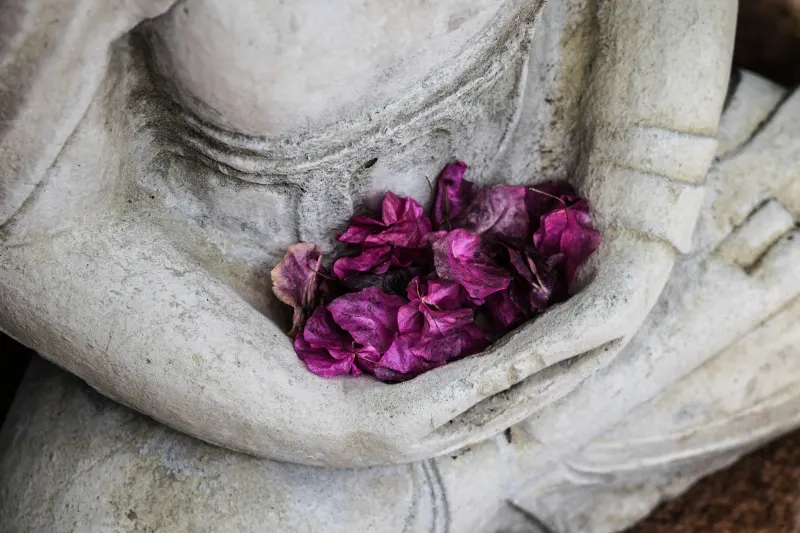
The Many Layers of Dharma
Open a Buddhist text and you meet a deceptively simple word: "dharma." It sounds singular and stable, like a stone. In practice, it is more like a prism; turn it slightly and different meanings flash forth. Understanding these layers is the first step to inviting a more thoughtful, spacious feeling into your home and your daily routines.Etymologically, "dharma" comes from a Sanskrit root meaning "to hold" or "to support." At its widest, it refers to the underlying order that holds reality together, the way gravity holds your body to the floor. In early Buddhist usage, this idea of a supporting order becomes more specific: the Buddha’s teaching on how suffering arises and how it can end. When Buddhists say they "take refuge in the Dharma," they are placing trust in this path of insight, ethics and meditative discipline that supports a more lucid life.
But the word bends again. In many classical Buddhist texts, "dharma" (often written with a small "d") can mean "phenomena" or "elements of experience": sounds, memories, emotions, atoms, moments of consciousness. In this sense, the world you inhabit at any instant is a shimmering pattern of dharmas coming into being and fading out. This is not metaphysical poetry; it is an invitation to look closely. When you notice light slanting across the floorboards, the faint hum of the refrigerator, the feel of ceramic in your hand, you are quietly practicing seeing dharmas as they arise.
There is also the ethical nuance of dharma as right conduct, the way of living that "supports" inner clarity rather than confusion. This overlaps with other Indian traditions, where dharma can mean duty, role and social responsibility. Buddhism subtly reframes this: more than a fixed social script, dharma is alignment with the Four Noble Truths and the Eightfold Path. Your actions, speech and livelihood are measured against whether they reduce greed, ill will and delusion, or reinforce them.
Held together, these meanings sketch a surprisingly cohesive picture. Dharma is both the structure of things and the instructions for living within that structure without unnecessary friction. It is the pattern and the path. When brought into the realm of interiors and daily life, this becomes a question of arrangement: how can your external space "support" inner stability rather than scatter it? The philosophical and the domestic are not separate spheres but reflections in the same clear bowl.
Dharma in Practice: From Cushion to Living Room
Theory only becomes dharma in a Buddhist sense when it is lived. In monasteries, this means meditation schedules, shared chores, simple meals and the choreography of ritual. The idea is not austerity for its own sake but the careful shaping of an environment that nudges the mind toward presence. The built space is a silent teacher; the way a courtyard is framed, the uncluttered hall, the single flower on an altar all embody priorities.In a layperson’s home, there is no need to recreate a monastery. But the underlying logic is transferable. If dharma is what supports clarity, then it becomes a practical design question: what in this room supports attention, kindness and ease, and what subtly erodes them? The answer will differ from person to person, but Buddhist practice suggests some stable principles.
First is awareness of impermanence. In classical Buddhist analysis, all dharmas are transient; the cup will chip, the paint will fade, your preferences will change. A dharmic home does not fight this truth with frantic perfectionism. Instead, it leans into materials that age with some dignity, accepts patina and resists overaccumulation. When you choose a wooden table that can scratch and still feel beautiful, you are tacitly acknowledging that life will leave marks, and that this is not a failure but a record.
Second is interdependence. Each object in a room exerts a quiet influence on everything else. The chair determines your posture; the window determines your sense of horizon; the television’s mute presence shapes the evening even when it is off. Buddhist thought extends this to all phenomena: your state of mind is never purely your own; it is shaped by air quality, conversation, light, memory. Designing with dharma in mind means noticing these chains of influence and rearranging them with intention. A single corner cleared of visual noise and dedicated to reading, meditation or simply looking out the window can soften the tone of an entire apartment because it introduces a new relational center of gravity.
Third is compassion. At first glance, compassion might seem like an inner attitude rather than a design principle. Yet when dharma is taken seriously, compassion is not an optional ornament but a structural beam. If the goal is to reduce suffering, then a home is also evaluated by how gently it holds the bodies and minds that move through it. Seating that does not punish the back, pathways free of obstacles for elders and children, light that does not glare relentlessly at night: these are concrete expressions of a compassionate dharma. They are small, physical ways of saying "may you be at ease here."
Finally, there is simplicity, which in Buddhism is less about aesthetic minimalism and more about non-grasping. You can own beautiful things without being owned by them. The difference lies in whether objects are chosen because they genuinely serve and uplift, or because they promise an identity you are chasing. A dharmic approach to home asks of each possession: what mental state does this encourage when I meet it every day? Restlessness, comparison, nostalgia, gratitude? You begin to edit and arrange not for show but for psychological tone.
In this way, "dharma" ceases to be an abstract term from distant sutras and becomes a quiet, organizing question that you return to again and again: what, in this moment, truly supports what matters? On the meditation cushion, the answer might be a straighter spine and a softer breath. In your living room, it might be a cleared table, a few well-loved objects and a patch of morning light left unobstructed. In both cases, the practice is the same: learning to live in alignment with the pattern that is already there, revealed a little more each time you choose with care.

.webp)