The Enso Circle and the Art of Imperfection
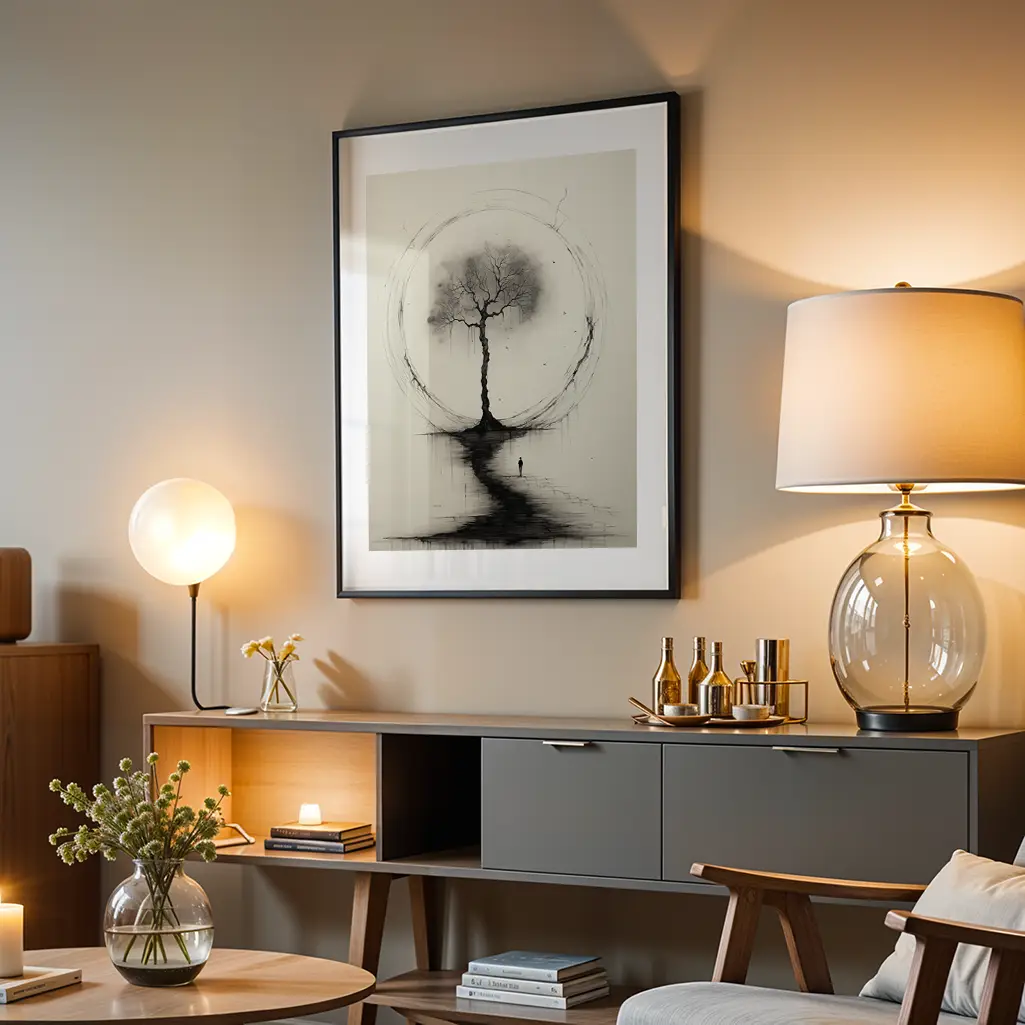
"The Enso circle meaning" begins with a single, unbroken gesture. In Zen practice, an Enso is drawn in one fluid stroke, often with ink on paper, sometimes in the breath between two meditations. It is a circle, but not geometry; a shape, but also a moment. What appears as a simple loop is, in fact, a compressed record of attention, hesitation, confidence, and release.
Traditionally, an Enso is painted when the mind is steady yet unforced. The brush dips into ink, then arcs across the surface without correction. There is no going back to thicken the line or tidy the wobble. This immediacy is central to its symbolism. The Enso is less a picture of perfection than a snapshot of presence.
Look closely at famous Enso paintings and you notice how wildly they differ. Some are dense and heavy, the ink nearly pooling. Others are faint and almost brittle. Some close fully, a sealed universe. Others are open, the circle interrupted, suggesting movement into and out of the form. The variations are not mistakes. They are the visual signature of a particular person at a particular instant.
In Zen, this is often described as the trace of "suchness." The Enso reveals things as they are, without decoration. Your wrist strength, your breathing, the softness or stiffness of the brush, even the humidity of the air, all appear in the circle. It manifests "wabi-sabi," the quiet Japanese appreciation for impermanence and imperfection. A tremor in the line is a reminder that life does not run along a ruler-straight path.
The empty center of the Enso is as meaningful as the ink. In that openness, Zen sees both "emptiness" and fullness. Emptiness, not as a void to fear, but as the uncluttered ground from which all things can arise. A blank center allows the eye to rest. It also allows the viewer to project their own experience inward. Some see the quiet at the core of a storm; others see a window or a portal. This dual quality makes the Enso a companionable symbol for the home, where you might be seeking both calm and a sense of possibility.
At the same time, the enclosing stroke gestures toward wholeness. The Enso contains dualities without resolving them: imperfection and completeness, self and environment, inner life and outer tasks. To live with an Enso is to be gently reminded that the day can feel unfinished while you yourself remain whole.
Bringing Enso Symbolism into Your Home
When you consider how the Enso circle might live on your walls or shelves, it helps to remember its origin as an actual, physical practice. In traditional settings, a Zen teacher paints an Enso in the quiet after meditation, then sets it aside without comment. The circle is not meant to impress but to serve as a mirror. In a domestic space, the same quality can soften the way objects relate to you.
If you place an Enso near a busy threshold, such as an entryway or a kitchen pass-through, the open center can act almost like a visual pause button. The eye lands on the circle, dips into its emptiness, and returns to the rush of keys, bags, and conversation with a fraction more space around each movement. For a home office, an Enso behind or beside your desk can temper the hard edges of screens and spreadsheets. Its irregular curve stands in quiet disagreement with the grid of your calendar.
Color and material matter. A black ink Enso on white paper feels sharp and contemplative, its contrast echoing the ancient calligraphic tradition. A softer gray, or even a painted Enso on a textured wall, can blend more easily with muted interiors, adding a subtle pulse rather than a shout. The goal is not to make the symbol into another design trend, but to let it be a slightly off-center heartbeat in the room.
There is also a decision between a closed and an open Enso. A closed circle tends to read as containment, like a bowl or a halo. An open Enso, with a visible gap, reads as an invitation. In a small apartment or studio, an open Enso can suggest that the space extends beyond its physical limits. The line breaks, the mind follows through. In a more formal living room, a closed Enso may feel like a silent anchor amid more ornate furniture or layered textiles.
Just as important as the symbol itself is the space around it. An Enso hemmed in by crowded frames or decorative clutter loses its breathing room. Try placing it on a wall where there is a margin of emptiness, allowing the circle to echo its own center. This negative space is not wasted; it is the interior design version of a rest in music. It gives rhythm to everything else.
Practicing Enso for a More Present Home
The deepest "Enso circle meaning" is not unlocked by looking at it but by making it. You do not need formal training in calligraphy to explore this. A cheap brush, a small pot of ink or watered-down paint, and a stack of scrap paper are enough. What matters is the willingness to let the hand move in one unedited arc.
Try standing at a table, taking a slow breath in, and then, on the exhale, drawing a single circle. Resist the urge to fix it. Set the paper aside, then draw another. Some circles will be oddly lopsided, some timid, some unexpectedly bold. Each one is a visible record of how you arrived at the page in that instant. Over time, you may find that your circles become steadier, or that you make peace with their wobble.
This small practice can change the way you arrange your space. After ten or fifteen circles, the difference between forced and unforced gestures becomes obvious. You may begin to notice similar tensions in the way you overfill a bookshelf or stack cushions on a sofa. The Enso becomes a teacher of restraint: not an austere minimalism, but a careful listening to when a room feels complete enough.
You might frame one of your own Ensos rather than buying a perfect reproduction. Its line will carry the memory of a particular season in your life. Hung in a hallway or above a low table, it can serve as a reminder that the home is not a showroom but a lived-in circle: sometimes open, sometimes patched together, always in motion. The signature wobble of your hand is, in a quiet way, a declaration that your space is already whole, even as it changes.
In this way, the Enso moves from symbol to shared practice. It links your breathing to your brush stroke, your brush stroke to your wall, and your wall to the daily rituals that unfold around it. A simple painted circle becomes a companion, offering, without words, the assurance that life can be both unfinished and complete, and that a home, like an Enso, is most alive when it leaves a little gap for what comes next.

.webp)