When Words Become a Room You Can Live In
“Zen quotes that actually help” are less about sounding wise and more about changing how your body feels when you cross a threshold. The useful ones do something concrete: your shoulders drop, your breath slows, you put the mug down a little more gently. That is the test. If a line is only good for an Instagram caption, it tends to stay on the screen; a real Zen phrase quietly rearranges how you move through your rooms.Zen teaching was never meant to be ornate. It is full of short, almost blunt sentences that land in the body first and the intellect second. This is what makes them unexpectedly practical for interior life. Think of them as tiny design briefs: compressed instructions that can guide how you use light, what you keep, what you hide, even how you argue in the kitchen.
Consider a classic: “When you are hungry, eat; when you are tired, sleep.” On the surface, it sounds like something embroidered on a pillow. Taken seriously, it has teeth. It tells you to stop designing your home around performance and start designing it around functions your nervous system actually needs. If you are exhausted by evening, you do not need a “statement sofa”; you need a chair in a quiet corner where your body feels allowed to collapse without apology.
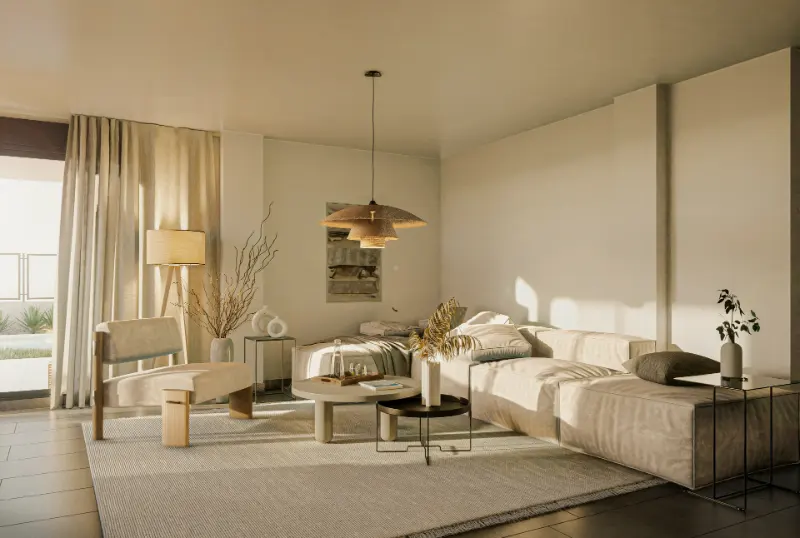
In that way, a good Zen quote behaves like a subtle architect. It keeps asking, Does this room make it easier or harder to be human here. Instead of chasing an aesthetic, you begin to ask how a sentence might translate into a surface, a doorway, a habit. Your apartment becomes less like a showroom and more like a shrine to uncomplicated behaviors: reading, eating, talking, quietly staring at nothing in particular.
The point is not to decorate with words but to let a few carefully chosen lines become invisible structural beams behind your decisions. Invisible, because the most helpful phrases for daily life usually cannot be seen; they are felt when you reach for yet another decorative object and then, for some reason, decide not to.
From Quote to Corner: Translating Zen Into Space
Take another line that Zen students hear often: “Sitting quietly, doing nothing, spring comes, and the grass grows by itself.” In design terms, this is a reminder that not everything in a room needs your interference. There is a relief in allowing a bare stretch of wall, in choosing a low plant that will quietly lean toward the light on its own schedule, in letting a window remain simple instead of layering it with treatments meant mostly to prove taste.Applied literally, this quote could become a corner with a single cushion, a low table and nothing else. No tray, no styled stack of books, no candle balanced on a ceramic object shaped like an idea of serenity. The emptiness is the point. A place in the home where the only program is to sit and let time move without you managing it. In such a corner, the line about grass growing by itself is no longer metaphor; it is the feeling of a room that does not require your constant editing.
Another Zen phrase frequently misunderstood is “Let go or be dragged.” On social feeds, it circulates as motivational toughness. Brought quietly into your living room, it becomes a policy about ownership. Each object either supports your daily rituals or drags behind you as a small responsibility. A mug that chips but still makes you smile is not dragging you. A box of cables you have not opened in five years is.
The practice here is not ruthless minimalism; it is something more like honest hospitality toward yourself. Walk through your home with the quote in mind and notice where your eyes snag, where you feel an almost physical pull of obligation. That leaning tower of unread magazines does not need more attractive storage; it needs a clear decision. Keeping them is fine if you will actually read them. If not, the kindest design move is release.
Then there is the line “Wherever you are, be there totally,” often dismissed as mindfulness boilerplate. But imagine using it as a zoning rule. If the table is where you eat, you do not doom it to become a permanent office. If the bed is where you rest, you do not invite every glowing screen into it. Being “totally” in a place can be supported through small design choices: a basket by the door that catches your phone at dinner, a real clock in the bedroom so the alarm no longer comes with a dose of news and comparison.
In this way, Zen language can shape your floor plan more than any trend forecast. A kitchen arranged for presence rather than performance might have fewer gadgets but better light, a place for one knife to live, and a single sturdy pot that invites you to cook the same few meals well. A hallway guided by the idea of not being dragged might contain only what you actively reach for in a week, not the coat you once loved in another city, another life. The words do not live on the wall. They live in the way you move, and over time, the house begins to echo back the calmer person it has been quietly helping you to become.
Quiet Lines for a Quieter Daily Life
The most underrated Zen quote for home life might be “Not always so.” It sounds abstract, but in a domestic context it becomes a loosening agent. The living room does not always have to host. The dining table does not always have to be cleared. Your own mood is not always the same, and your rooms can be allowed to reflect that without self‑critique.“Not always so” gives you permission to let the Sunday blanket stay on the arm of the chair until Tuesday, to leave the book open on the floor side of the bed, to move the plant three times until you find the window where it looks, inexplicably, older and more sure of itself. The quote becomes an interior design principle that values responsiveness over fixed perfection.
There is a temptation, with any philosophy, to turn it into authority. Zen is oddly resistant to that. A line like “No snowflake ever falls in the wrong place” can sound fated and heavy handed. Read more gently, it becomes a way of relaxing the tight grip on how your home is “supposed” to look at a particular age or income. The hand me down table, the mismatched plates, the plant that refuses symmetry, all of these can be seen not as design compromises but as the particular weather of this season of your life.
What matters is whether you can breathe more easily in the rooms you inhabit. If a quote helps with that, it has done its work. If it makes you feel inadequate, like another standard you are not meeting, it can go. Real Zen language tends to shrink the ego, not inflate it. It whispers that the most radical thing you can do with a home is to let it be a place where you are unembarrassed by your own existence.
So you choose a small handful of sentences and allow them to guide decisions you might have made on autopilot. You repeat “When you are hungry, eat” and finally clear a lower shelf so snacks and plates are reachable without a step stool or a search. You remember “Let go or be dragged” when you open the closet and, just once this week, release one thing that no longer belongs to the person you are becoming.
Over time, these phrases sink below language. Guests might only notice that your home feels strangely restful, or that the light seems to fall in a way that invites them to stay a little longer, or that there is an absence of pressure to be interesting. The walls will still be painted in ordinary colors. The furniture will age. But under it all, a few clear lines will continue their quiet work, turning the place you live into something closer to what Zen has always promised: not a performance of calm, but an ordinary life that finally fits.

.webp)