Reframing the Blank Box
A rental that forbids painting or drilling can feel like an affront to adulthood, as if your taste has to be “on hold” until you own something. Yet the constraint is not purely punitive; it is also clarifying. When walls and floors are fixed, attention shifts to everything you can move, layer or light, which is where most of the visual and emotional experience of a home actually lives.Walk through any thoughtfully designed space and notice how rarely paint color is doing the heavy lifting. Instead, the atmosphere comes from light, proportion, texture and repetition. In a rental, you simply lean harder on those tools, using them to visually “re-skin” the space without leaving a mark.
Begin by deciding how you want the home to feel, not how you want it to look. “Calm,” “lively,” “cocooned,” “airy” are more useful than “midcentury” or “Scandinavian.” Feeling words point you toward materials and densities. Calm suggests fewer contrasting patterns and a tighter palette. Airy suggests leggy furniture and translucent fabrics. Once you name the feeling, every decision, from curtain fabric to lamp height, can be measured against that intention.
A blank rental also benefits from choosing one or two subtle “through-lines.” These can be as simple as a repeated material, like pale wood, or a recurring shape, like soft rounded corners. When colors on the existing walls or floors are not negotiable, repetition is what makes them recede. The more your eyes recognize a consistent language in furniture, art and textiles, the less attention they pay to the original finishes you dislike.
The architectural shell may be generic, but your belongings are not. Instead of battling the landlord’s eggshell paint, think of the apartment as a gallery for your own portable architecture: rugs that define rooms, lighting that reshapes volume, and vertical elements that create rhythm where there are no moldings or built-ins. The job is not to erase the rental; it is to overtake it, gracefully, with layers that can all leave with you.
Surface, Fabric, and Light as Your Toolkit
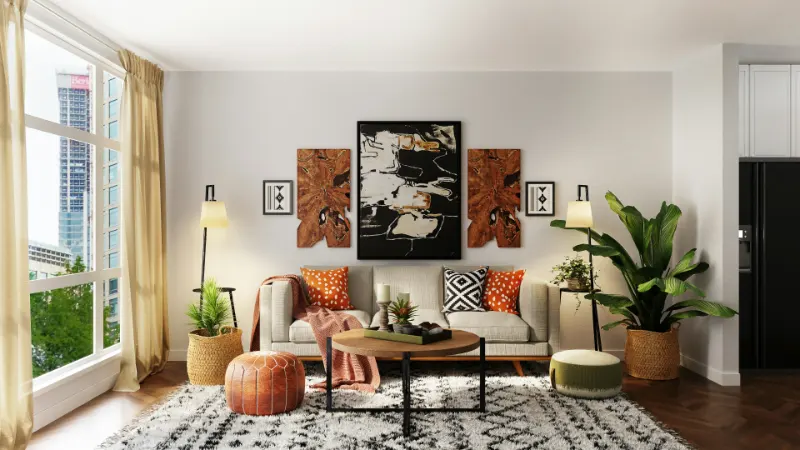
Without painting or drilling, surfaces become your primary medium. The floor is the largest continuous surface you can control, so it deserves more thought than it usually gets. A rug is not just decoration but a kind of reset button for the eye. A dark, busy rental floor can be visually lowered and quieted with a large flat-weave in a softened tone; a cold, pale floor can be warmed with deeper colors and thicker pile. If you cannot afford one expansive rug, let two or three similar ones “kiss” under furniture so they read as one field. The point is to create intentional islands, so that even if the perimeter is bland, the lived-in core feels deliberate.Vertical surfaces can be transformed without nails if you treat them as temporary stages, not permanent canvases. Leaning art, mirrors or large framed textiles against the wall—on consoles, mantels, shelves or even directly on the floor—creates the kind of visual punctuation drilled art usually provides. A tall floor mirror in a corner both amplifies light and behaves like an extra window. If you need more order, tension rods inside alcoves or between bookshelves can support lightweight panels of fabric or cane, giving the sense of architectural inserts that never touch the drywall.
Textiles do much of the emotional work in a no-paint, no-drill rental. They soften acoustics, obscure awkward features and adjust the psychological “temperature” of a room. Curtains, for instance, are not merely about privacy. Mounting them on adhesive hooks or pressure rods that hug the window frame allows you to visually widen a narrow window by extending fabric beyond the casing. Choosing the right weight is a kind of mood control. Sheers in a high-traffic living space keep things bright but slightly diffused, like tracing paper over the city. Heavier linen or cotton in a bedroom can make a standard window feel like a hotel drape, especially if the fabric pools lazily on the floor.
Lighting, meanwhile, is the most underestimated tool for reshaping a rental without leaving a single hole. Overhead fixtures in rentals are often utilitarian, and you may not be allowed to replace them. Instead of accepting their harshness, route around them. Plug-in sconces, swagged from adhesive ceiling hooks, can mimic wall lighting as long as you are willing to let the cord become a graphic element rather than something to hide. Floor lamps with shades at eye level create what lighting designers call “human scale” illumination, in contrast to the faraway glare of a ceiling can. A mix of table lamps, floor lamps and even small clip-on lights attached to shelves can create soft pockets of light that gradually connect, making the original ceiling fixture feel almost irrelevant.
This is where deep reasoning about the space matters. Ask yourself not “Where does a lamp usually go?” but “Where does shadow fall in a way that makes this room feel smaller or meaner than it is?” Then put light there, at a warm color temperature, and notice how the geometry of the room seems to relax.
Composing Rooms with Portable Architecture
When you cannot alter walls, you can still change what those walls are asked to do. Freestanding storage, screens and shelving act as “portable architecture,” drawing new lines without a drill. Open bookcases placed perpendicular to a wall can divide a studio into sleep and living zones while still letting light move through. A slim console table at the back of a sofa can create the illusion of a hallway in an entryless apartment, giving you a landing strip for keys and mail so the front door does not open abruptly into chaos.In rentals, scale is often misjudged out of fear: people choose pieces that are too small, hoping they will be easier to move later. The result is a flotilla of anxious little objects that never quite cohere. A better strategy is fewer, larger gestures that are still portable. One generous dining table that doubles as a desk; one substantial headboard, even if it is just an upholstered panel leaning between bed and wall; one tall plant that reaches into the upper third of the room’s height and softens an empty corner. These structural moves make the space feel “finished” without ever changing the landlord’s property.
You can also use pattern as a kind of immaterial architecture. A bold runner defines a hallway that may not be demarcated by walls. Repeating the same stripe or check in different rooms—on pillows, a throw, a lampshade—helps them feel connected, like chapters of one story instead of mismatched sublets. Even the objects you already own can be edited into coherence. Rather than scattering sentimental items everywhere, cluster them with intent. A group of travel objects on one shelf becomes a quiet narrative altar; the rest of the surfaces are then free to be calm, which reads as design rather than accumulation.
Finally, one of the most potent things you can do in a restrictive rental is to curate absence. When you cannot customize the bones, negative space becomes your most luxurious material. Leave a stretch of wall bare so that a single leaning artwork can breathe. Allow a clear path from door to window so light can travel unimpeded. Removing a piece of furniture that is half-right but in the way can have more impact than adding three new accessories. The home you are designing is not an argument with your landlord’s rules; it is a conversation with your own daily rituals. If every object has a reason to be there now, you will carry that clarity with you to whatever you decorate next, painted walls or not.