The Quiet Psychology Of Bringing The Outside In
“Nature-inspired decor” is one of those phrases that sounds like a style trend but behaves more like a nervous system tool. You notice it when you walk into a room with a bowl of river stones on the table, a plant leaning toward the window, light slipping across a wooden floor. Your breathing changes by a degree or two, almost imperceptibly, yet very much in the body. The space feels more grounded, and so do you.
This is not only about beauty. It is about how our brains and bodies respond to cues from the natural world, even when those cues are only suggested by materials, shapes and light. We evolved outdoors, calibrating ourselves to the colors of soil and leaves, the fractal branching of trees, the sound of wind. A room that nods to those patterns does something ancient and practical for us: it reduces cognitive load.
Cognitive load is the effort your mind spends just to make sense of what it sees. Hard angles, glossy surfaces and cluttered patterns demand constant micro-decisions and micro-adjustments. In contrast, natural forms tend to feel familiar before you even process them. A linen curtain that falls in soft folds, a tabletop with a visible grain, a ceramic lamp with a subtly irregular silhouette; your brain recognizes these as part of a world it knows how to inhabit.
There is also the gentle discipline of color. Nature rarely shouts in pure, saturated tones. Even a red leaf is veiled by brown, green or gray. When you build a room around the palette of a shoreline or a forest—the warm beiges of sand, the muted greens of lichen, the deep browns of wet bark—you create a spectrum that is easier on the eyes. Your gaze can wander without colliding with anything harsh. That ease is a kind of grounding, a quieting of background noise.
Light might be the most powerful element of all. Imagine a sofa placed so that morning light washes across its arm, or a reading chair pulled close to a window instead of a wall. The sun becomes an active collaborator in your decor, articulating textures, changing the room hour by hour. Even at night, a lamp with a warm, diffuse shade can imitate dusk, coaxing your body toward rest rather than alertness. What people often describe as a “serene” room is usually one where light has been allowed to behave almost like weather: variable, soft, and in dialogue with the objects it touches.
The key is not to recreate a forest in your living room, but to honor certain principles that nature uses generously: variation inside coherence, rough against smooth, a living thing beside a still thing, openness punctuated by shelter. These are the patterns that tell your body it has somewhere to land.
Materials, Forms And The Subtle Art Of Calm
When people begin to experiment with nature-inspired decor, they often start with plants. It is an intuitive choice, and a good one. A single healthy plant can introduce movement, color, and the pleasing unpredictability of growth. But the grounding effect of nature does not end with foliage. It extends to what you place under your feet, what you touch with your hands, what you see in the corners of your eyes as you move through the room.
Natural materials have a specific kind of honesty. Wood keeps its knots and rings, stone its specks and veins, wool its faint irregularities. These imperfections are not flaws; they are information. They remind you that the objects around you had a life before they entered your home. When you sit at a wooden table and notice the fine line where the grain curves, you are in conversation with time, and there is something stabilizing about that.
Texture plays a parallel role. A smooth plaster wall beside a coarser jute rug, a glazed vase next to an unglazed one, a tightly woven cotton next to a looser knit; your hand and eye move between these surfaces, and in doing so, they slow down. Texture gives your senses something to explore without urgency. This is different from visual clutter, which scatters your attention. Where clutter is many ideas competing at once, well-chosen texture is a few ideas thoroughly developed.
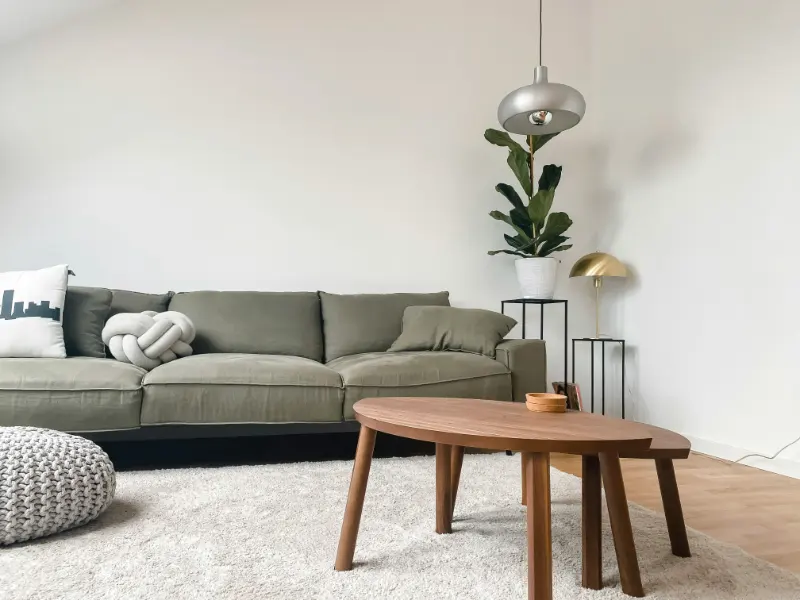
Form matters as much as material. Straight lines and right angles are not the enemy; they provide structure. But when everything in a space is rigid and rectilinear, the body can feel like it has nowhere soft to rest. Nature-inspired decor often brings in curves and irregular silhouettes as counterpoints: a round coffee table near a linear sofa, a lamp with a gently tapering shade, a mirror with an oval frame instead of a perfect rectangle. These “biophilic” forms echo the way branches bend, rivers turn, stones weather. They let the eye travel in arcs instead of hitting a wall and stopping.
There is a psychological dimension to this softening. Curves feel less defensive than corners. A space with a few rounded edges reads as more welcoming, less guarded. That friendliness, contained in shape alone, can make a home feel like it is on your side rather than demanding performance from you. When people say a room feels “grounded,” they are often describing this sense of being met where they are, held instead of evaluated.
Grounding, in the end, is about relationship: between you and your environment, but also among the elements of the room itself. A linen-covered sofa, a wool throw, a clay mug, a small tree in a simple pot; each one speaks a slightly different dialect of the same language. The more fluently they converse, the calmer the room feels. When you choose pieces that share an underlying connection to the natural world, you are not merely decorating. You are building a gentle ecosystem indoors, one that remembers what your body has never forgotten: that you come from a place with weather and seasons, with bark and water and light, and that part of you relaxes the moment you are allowed to live there again, even in the middle of a city, even three floors up.